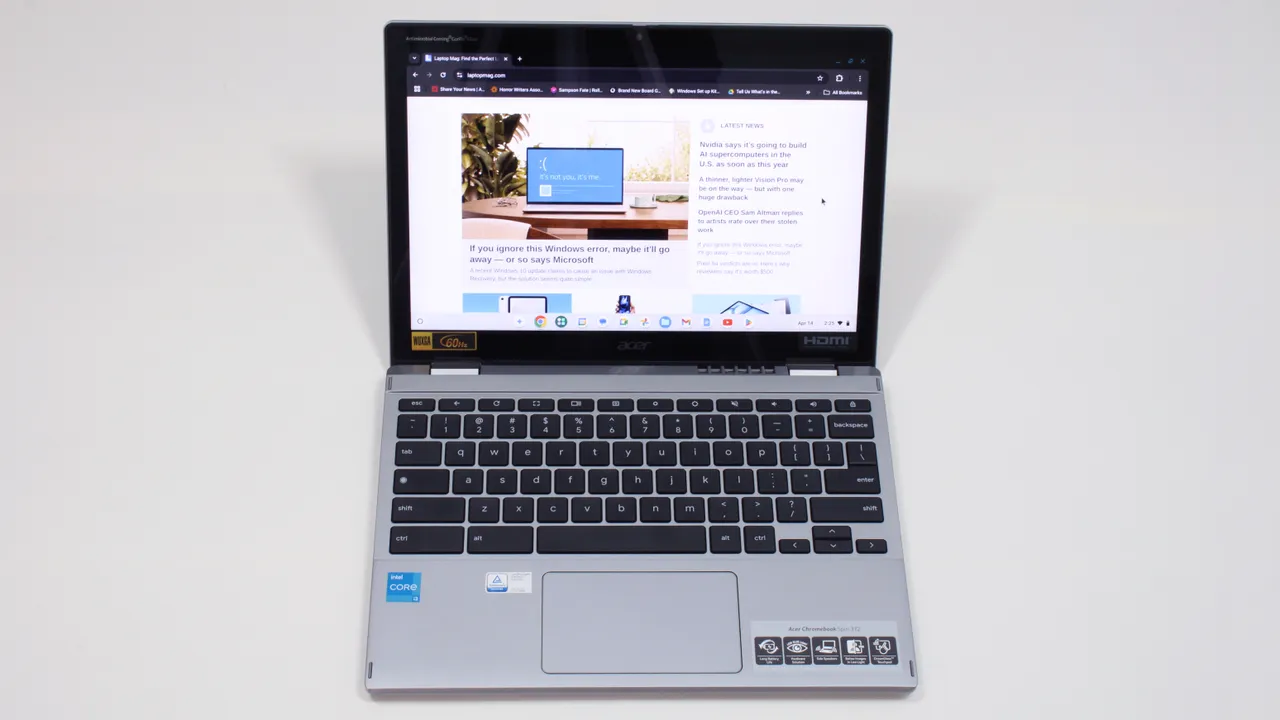
Laptop Mag Verdict
The first 12-inch mini-notebook packs a spacious screen and keyboard in a very slim design, and it offers very good battery life, but the Mini 12's performance could be better.
Pros
- +
Glossy 12.1-inch screen
- +
Slim design
- +
Excellent battery life with six-cell battery
- +
Nearly full-size keyboard
Cons
- -
Sluggish performance under Vista
- -
Slow hard drive
- -
Quiet speakers
Why you can trust Laptop Mag Our expert reviewers spend hours testing and comparing products and services so you can choose the best for you. Find out more about how we test.
Befitting their name, mini-notebooks have been defined by small 7 to 10 inch displays. Not anymore. The Dell Inspiron Mini 12 ($654 as configured) redefines the category by being the first to feature a 12-inch display. It's also less than an inch thick, giving the Mini 12 the profile of a high-end laptop or ultraportable.
However, this is still very much a netbook designed for anytime, anywhere Internet access; it's not a productivity workhorse nor multitasking maestro. The 1.6-GHz Intel Atom processor, 1GB of RAM, and slow 4,200-rpm, 60GB hard drive tell you that this is a companion device. Even among netbooks, however, the Mini 12's performance is less than stellar (thanks to Windows Vista) even though we appreciate the more than 5 hours of battery life offered by its six-cell battery.
Sleek, Slim Design
The Mini 12 shares the same design DNA as theMini 9. The rounded lid sports an identical glossy black coating (a white version will also be available) which is prone to fingerprints. Underneath the hood, the black keyboard is offset with a smooth silver palm rest and screen bezel.
The most striking aspect of the Mini 12's design is its thin stature, making it reminiscent of slender--and

Click to enlargeexpensive--ultraportables, such as theVoodoo Envy 133,Lenovo ThinkPad x300, andApple's MacBook Air. Measuring 11.8 x 9.0 x 0.9 inches at its thinnest, the Mini 12 is longer and wider than such 10-inch systems as theMSI WindandSamsung NC10, but it boasts a similar weight, tipping the scales at 2.8 pounds with its three-cell battery and 3.2 pounds with its six-cell battery. While we couldn't just toss it into a purse, as with the Mini 9, the Mini 12 slid into a shoulder bag without a problem. At 3.6 pounds with its AC adapter, this netbook still felt pretty darn light.
The extended batteryprotrudes from the bottom of the system, raising the back of the Inspiron Mini 12 slightly; when sitting on a desk, it sets the keyboard at a comfortable angle for typing.

Click to enlargeThe bulk of the Mini 12's weight is positioned toward the hinge; as a result, when the three-cell battery (which sits flush) is inserted, the notebook has a tendency to tip backwards when resting on a lap and balance on its hinge.
Spacious Keyboard and Touchpad
Unconstrained by the smaller chassis inherent in mini-notebooks, one of the best features of the Mini 12 is its keyboard. The 92 percent-full-size layout is fine for touch typists and requires no accommodations in typing patterns. Unlike the Mini 9's keyboard, the Mini 12 contains a dedicated row of Function keys, and the right Shift key has been slightly expanded. Nevertheless, some keys have been shrunk to make room, including the period and comma keys. Overall the keyboard was void of any flex and provided nice feedback.

Click to enlarge
The touchpad is similarly large and spacious and has a slightly textured surface. However, because of its large size and its position immediately below the keyboard, we accidentally moved the cursor or minimized windows with the palm of our hand from time to time. The two mouse buttons, located below the touchpad, were easy to click.

Click to enlargeThe Dell Mini 12 is well equipped with ports: three USB, as well as VGA, Ethernet, headphone, and microphone jacks surround the system. A 3-in-1 card reader is on the right side.
Roomy Screen, Low Audio
The 12-inch, 1280 x 800-pixel resolution glossy screen makes all the difference to the netbook experience. Compared with 10-inch displays such as those found on the MSI Wind orEee PC 1000H, the extra two inches allowed us to keep two Web pages open side by side and read them comfortably. We also didn't find ourselves reaching for our larger notebook to accomplish certain tasks such as editing a batch of pictures. The screen has just the right amount of gloss, and horizontal viewing angles were good: a friend sitting next to us was able to watch a YouTube clip, and tilting the screen back caused minimal glare.
Above the display is a 1.3-megapixel webcam, which worked nicely in Dell's Video Chat powered by Sightspeed; our caller saw us clearly but complained of a slight green hue to the picture.
While the Mini 12 doesn't bury its speakers below the chassis like many netbooks do--instead placing them across the top of the keyboard--they were weak. Even when cranked up to full volume it was still hard to hear from the other side of a small apartment.
Dell Dock Software
To make Vista more user-friendly, Dell has included its Dock on the desktop. This panel of oversize icons located on one edge of the screen is reminiscent of the Mac OS X dock. By default, the Dell Dock runs along the top edge, but you can customize the location as well as its color schemes and content. Customizing the dock is as easy as dragging and dropping an icon from the desktop or Start Menu. For example, we added Firefox to the Web dock menu option.
Hardware Limitations
The Mini 12 was not made for netbook tinkerers. The Mini 12's processor does not support more than 1GB of RAM. The hard drive uses a less common PATA/ZIF interface (as opposed to SATA), so there are very few options on the market to replace it.
Performance and Graphics
While most mini-notebooks to date have used the same 1.6-GHz Intel Atom N270 processor, Dell opted for a 1.6-GHz IntelAtom Z530 Silverthorne-class processor, which was designed for devices with smaller forms. The Mini 12 also includes 1GB of RAM and Microsoft Vista Home Basic. (Windows XP and Ubuntu will be available before the end of the year.)
The hardware had a bit of trouble keeping up with Vista: the Mini 12 didn't deliver the same punchy performance as other netbooks we've tested. While individual programs loaded at a decent rate (especially after removing preloaded applications such as Google Desktop and McAfee), the system lagged when multiple apps were open. When we tried a video call over Dell Video Chat while simultaneously writing a document in Microsoft Works and surfing the Web in Firefox 3, the Mini 12 was noticeably taxed, taking a few seconds to flip between applications. However, when we stopped the video call, the system recovered and worked without a hiccup. Working solely in the Web browser was not a problem; we were able to listen to streaming music over Pandora, as well as visit sites and edit blog posts.
The Intel GMA 500 chipset earned a score of 406 on 3DMark03, which is lower than the 537 category average. Similarly on 3DMark06, it notched a embarrassingly low 40--less than half that of the HP Mini 1000. Nevertheless, the Mini 12 managed to handle a video call while playing back an MPEG-4 video of Hercules.
Hard Drive Performance and Heat
The Mini 12's 60GB, 4,200-rpm hard drive boots Vista out of the box in a sluggish 2 minutes; more than 4 minutes passed before all of the preinstalled programs, including the Dell Dock, appeared (see our boot video below). We were able to get boot time down to about 1:30 by removing preloaded programs. The LAPTOP Transfer Test (copying a 4.97GB folder of mixed media) took 8 minutes and 52 seconds, or a rate of 9.57 MBps, which is about 8 MBps slower than the mini-notebook average. Still, application open times were decent, with most programs (including IE and Windows Media Player) starting within 10 seconds, though some took 15 seconds.
During testing, the Dell Inspiron Mini 12 got a bit hot on the underside of the unit, measuring about 99 degrees. The rest of the system, including the keyboard and touchpad, were not noticeably warm.
[flv:http://blog.laptopmag.com/flvs/dell-mini-12-boot-up.flv 480 360]
Strong Endurance, Wi-Fi
We were impressed with the Mini 12's six-cell battery, which lasted 5 hours and 20 minutes on the LAPTOP Battery Test (continuous Web surfing over Wi-Fi). The fact that it beat out all other mini-notebooks--except the Samsung NC10--is all the more impressive considering that the Mini 12 has a larger screen than all the others. However, the six-cell battery (which adds only $30 to the cost) adds a bit of bulk to the system. We will update this review with results from the smaller-capacity battery.
The Mini 12's 802.11 a/g Wi-Fi radio connected easily to our WPA-protected access point and delivered speeds of 19.2 Mbps and 13.7 Mbps from 15 and 50 feet, respectively; both beat out the mini-notebook averages of 16.9 Mbps and 13.2 Mbps. Web pages loaded quickly on our home network: NYTimes.com loaded in 6 seconds, and Laptopmag.com in 8 seconds. Streaming music over Slacker.com was smooth and void of pauses.
Software and Warranty
Beyond its Dell Dock, the company bundles the Mini 12 with Microsoft Works Suite, Google Desktop, and Dell's Video Chat powered by Sightspeed. The system also came with a 90-day trial of McAfee Anti-Virus. The Mini 12 has a standard warranty of one-year parts and labor with 24/7, toll-free phone service.
Verdict

Click to enlarge
The Dell Inspiron Mini 12 certainly breaks new ground by offering a bigger screen than any other netbook without adding much weight, and you'll get very good endurance with the six-cell battery. But while we applaud Dell's efforts to make Vista easier to use with its flashy dock, the Mini 12 doesn't have the right hardware to handle this OS. Plus, the 12-inch screen costs a premium; its price of $654 is about $150 more than the 10-inch Samsung NC10 ($499), which offers better performance, a bigger hard drive, and longer battery life. We suggest that buyers hold off until next month when Dell offers the Mini 12 with Windows XP or its customized Ubuntu Linux operating system.
Dell Inspiron Mini 12 (Windows Vista) Specs
| Brand | Dell |
| CPU | 1.6-GHz Intel Atom Z530 |
| Card Slots | 3-1 card reader |
| Company Website | http://www.dell.com |
| Display Size | 12 |
| Graphics Card | Intel GMA 500 |
| Hard Drive Size | 60GB |
| Hard Drive Speed | 4,200rpm |
| Hard Drive Type | SATA Hard Drive |
| Native Resolution | 1280x800 |
| Operating System | MS Windows Vista Basic with SP1 |
| Ports (excluding USB) | Ethernet, VGA, Microphone, Headphone |
| RAM | 1GB |
| RAM Upgradable to | 1 GB |
| Size | 11.8 x 9.0 x 1.1 inches |
| USB Ports | 3 |
| Video Memory | 64MB |
| Warranty/Support | One-year limited/24/7 toll-free phone |
| Weight | 3.2 pounds (with six-cell battery), 2.8 pounds (with three-cell battery) |
| Wi-Fi | 802.11a/g |