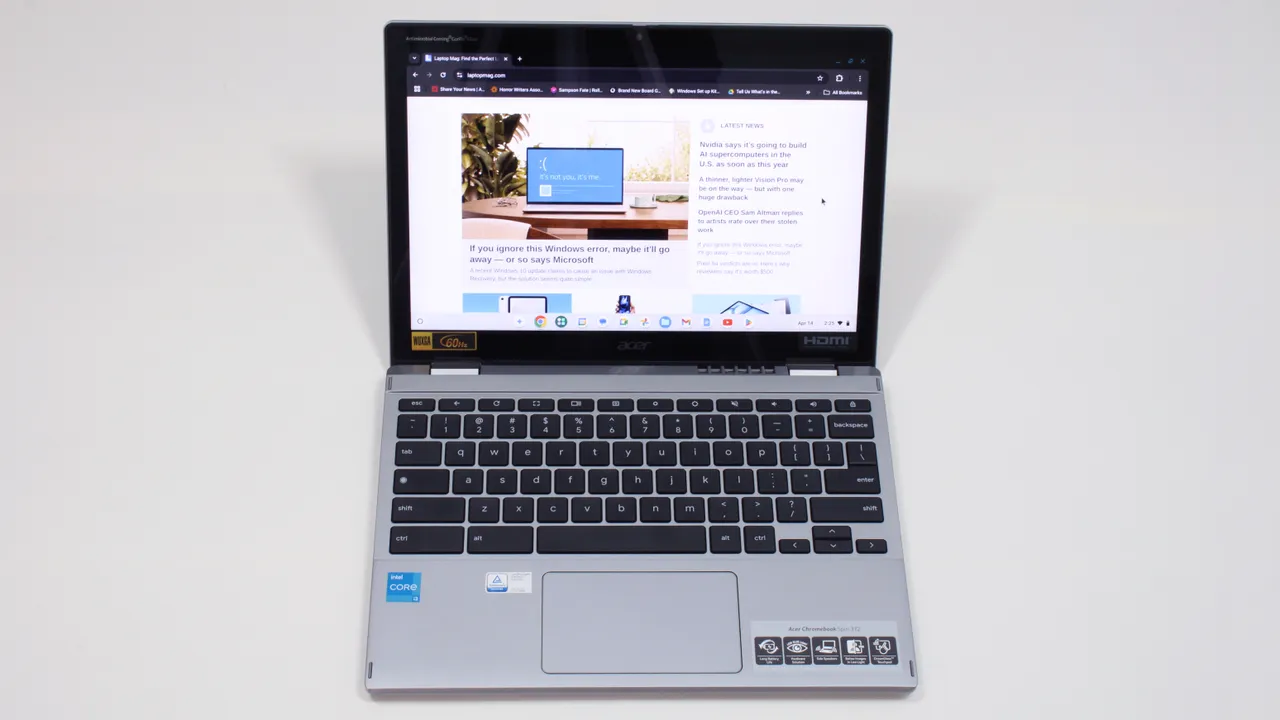
Laptop Mag Verdict
HP's second netbook sports a very good keyboard, a crisp 10-inch display, but we wish it had a larger battery.
Reasons to buy
- +
Roomy keyboard
- +
Bright, glossy display
- +
Stylish, compact design
- +
Very good Wi-Fi range
Reasons to avoid
- -
No six-cell battery option at launch
- -
Slow boot time
- -
Only two USB ports, and VGA requires adapter
- -
Relatively small, sluggish hard drive
Why you can trust Laptop Mag Our expert reviewers spend hours testing and comparing products and services so you can choose the best for you. Find out more about how we test.
When HP's2133 Mini-Note hit the market last spring, the category was still establishing itself: Intel's Atom processor had yet to arrive, and 10-inch screens had yet to become the sweet spot for mini-notebook displays. As a result, the 2133 fell behind other models. HP has now caught up to the competition with its 10-inch HP Mini 1000.
Our $549 unit (whichhas a starting price of $399 andcan be configured to order on HP's site) sports an Intel Atom processor, 1GB of RAM, and Windows XP, but what sets it apart is its extremely compact build and one of the best keyboards we've used on a netbook to date. However two things hold this system back from being our favorite: its three-cell battery and its higher price point.
Design
Measuring 10.3 x 6.6 x 1.0 inches and weighing 2.4 pounds, the Mini 1000, when placed next to its rival 10-inch netbooks (the Samsung NC10, ASUS Eee PC 1000H, Lenovo IdeaPad S10 and the MSI Wind) is definitively thinner and more compact. In fact, it compares favorably to smaller 8.9-inch netbooks, such as theAcer Aspire oneand Dell Inspiron Mini 9. When matched up with the razor-thin and much pricier $699Eee PC S101, the Mini 1000 is a mere 0.3 inches thicker and the same weight. When we tossed the HP Mini 1000 and the AC adapter (bringing the travel weight to 3 pounds) into a bag it felt almost non-existent, and with its durable finish we didn't worry about scratching its lid.

Click to enlargeHP replaced the aluminum chassis of the 2133 Mini-Note with a more affordable but still stylish plastic casing. The black lid, like the new Pavilion dv notebooks, is glossy and has HP's signature Imprint finish with a Swirl pattern. And unlike the Eee PC S101 or theDell Inspiron Mini 9, its pattern hid our fingerprints. The glowing blue wireless status light and the silver mesh, which covers the speakers that are nestled between the bottom of the screen and the top of the keyboard, project a futuristic look.
| Size and Weight Chart (inches and pounds) | Screen Size | Measurements | Weight |
| HP Mini 1000 | 10.2 | 10.3 x 6.6 x 1.0 | 2.4 |
| ASUS Eee PC 1000H | 10 | 10.5 x 7.5 x 1.5 | 3.2 |
| MSI Wind | 10 | 10.2 x 7.1 x 0.7 | 2.6 |
| Lenovo IdeaPad S10 | 10.2 | 9.8 x 7.2 x 1.1 | 2.6 |
| ASUS Eee PC S101 | 10.2 | 10.3 x 7.0 x 0.7 | 2.4 |
| Samsung NC10 | 10.2 | 10.3 x 7.3 x 1.2 | 2.8 |
| ASUS Eee PC 901 | 8.9 | 8.9 x 6.7 x 1.3 | 2.6 |
| Dell Inspiron Mini 9 | 8.9 | 9.1 x 6.8 x 1.3 | 2.3 |
| Acer Aspire one | 8.9 | 9.8 x 6.7 x 1.4 | 2.4 |
Superior Netbook Keyboard
The HP Mini 1000's keyboard is one of the best on a netbook to date. Not only is the 92 percent-size keyboard spacious and comfortable, the key positioning is near perfect. Unlike the Eee PC 1000H or MSI Wind, the right Shift key is full size and placed directly under the Enter key. Additionally, there is a complete row of dedicated function keys.

Click to enlarge
The keys on the Mini 1000 lack the 2133's DuraFinish, which made the keys resistant to visible wear and tear, a cost-cutting move. However, the matte black keys on the Mini 1000 are still softer to the touch than those found on its rivals. They each had pretty good tactile feedback, and the panel had no bend or flex. The only keyboard that can hold a candle to HP's is that of Samsung's NC10. Some of its keys aren't as large as the Mini 1000's, but some may prefer their chunkier feel.
Our appreciation for the Mini 1000's design lagged when we saw the touchpad, which has only been slightly altered from that on the 2133. The 2.4 x 1.1-inch touchpad is disappointingly small and vertically very narrow, resulting in a lot of back-tracking. Additionally, still present are the awkward right and left mouse buttons which vertically straddle the pad. This layout forced us to use both hands to access the buttons, or to double-tap on the touchpad quite a bit. Nevertheless, we don't think the touchpad is a deal breaker. We adjusted to the layout in a few hours. The touchpad also has a dedicated scroll bar, which was useful for moving through long Web pages; a button to turn off the pad lies above it.
Ports
Because the Mini 1000 is so compact, it doesn't have as many ports as some competing netbooks. While the system features two USB ports, Ethernet, and a 2-in-1 memory card reader, it loses a USB port from the 2133, a full-size VGA port (an expansion port on the left will fit a VGA-out adapter that is avilable from HP for $79) , and it has only a combo mic/headphone jack, rather than one dedicated to each. The Mini 1000 also lacks an ExpressCard slot, which the 2133 had, but you can easily add a USB mobile broadband modem.

Click to enlarge

Click to enlarge
Glossy Screen, Decent Audio
The speakers that straddled the screen on the 2133 have been moved to accommodate a larger 10.2-inch, glossy, LED-backlit display with a native resolution of 1024 x 600 (lowered from 1280 x 768 on the 2133). HP will also offer an 8.9-inch screen for on the HP Mini 1000 series.
The flush glass screen makes for a bright desktop, and Web pages fit to size on the screen. We were even able to keep a Web page and a document in Microsoft Works open side by side. An episode of 30 Rock streamed from Hulu.com looked extremely clear and detailed, and tilting the screen back 45 degrees (which is as far as it goes) didn't produce distracting glare. Horizontal angles were also good, and sharing the screen with another person wasn't a struggle.
The speakers, located on the hinge between the screen and the keyboard, produced loud but tinny sound when we cranked Leona Lewis' "Bleeding Love." Although adequate, we still prefer the ASUS Eee PC 1000H's fuller, Dolby-powered speakers.
The integrated 0.3-megapixel webcam on our review unit provided decent images in a video call over Skype; our caller could see our gold necklace clearly. The microphone, located to the left of the webcam, picked up some background noise, but our caller could hear us just fine without us needing to speak up.

Click to enlargeSolid Performance, Graphics
With the Mini 1000, HP nixed the VIA C7-M processor it uses in the 2133 for Intel's reliable (and ubiquitous) 1.6-GHz Atom processor. Along with 1GB of RAM, the Mini 1000 provided the netbook performance we've come to expect. We couldn't run our usual PCMark05 test on the system, but in our hands-on experience, the Mini 1000 was snappy. Firefox and Windows Media Player opened quickly, and we saw no performance hit when we conducted video calls over Skype, surfed the Web, and streamed music.
The Intel945GSE Expressintegrated graphics chip with 64MB of memory delivered a score of 743 in 3DMark03, about 200 points above the category average and 169 points higher than the Lenovo IdeaPad S10's 574, though just 4 points higher than the ASUS Eee PC 1000H. Watching a downloaded episode of the TV show Mad Men was smooth at full screen.
Hard Drive and Boot Time
Compared with other netbooks, the Mini 1000's hard drive holds a relatively low 60GB and runs at a slow 4,200 rpm, a trade-off for its very compact footprint. The ASUS Eee PC 1000H, MSI Wind, and Samsung NC10 are each available with a 160GB, 5,400-rpm hard drive.
The Mini 1000 booted Windows XP Home in a disappointing 64 seconds. The LAPTOP Transfer test (copying a 4.97GB folder of mixed media) took a sluggish 10 minutes and 59 seconds, a rate of 7.7 MBps. Other 10-inch netbooks in this class sport 5,400-rpm hard drives, which is why the Mini 1000 was significantly slower than the Lenovo IdeaPad S10 (4:53/17.4 MBps) and the Samsung NC10 (6:50/12.4 MBps). It is our hope that the 8GB and 16GB SSD storage options for the Mini 1000 will be faster.

Click to enlarge
Wi-Fi and Battery Life
The HP Mini 1000's 802.11b/g Wi-Fi card had the fastest transfer rates we've yet seen from a netbook, delivering a whopping 21.3 Mbps and 19.4 Mbps from 15 and 50 feet respectively. This blew away the MSI Wind (14.5/7.7 Mbps) and even the 802.11n-equipped ASUS Eee PC 1000H (10.4/6.1 Mbps). The only system with similar numbers was the Eee PC S101. You should be able to move a good distance away from your router at home or at hotspots and still expect good connectivity. Additionally, we enjoyed a strong connection in our day-to-day Web activities; streaming music over Slacker was fluid and watching video clips on Hulu.com were devoid of any pauses.
While HP tells us that a six-cell battery will be available in January, as of this writing, all the configurations available from HP feature three-cell batteries, as did our review unit. On our LAPTOP Battery Test (continuous Web surfing over Wi-Fi), the battery lasted 2 hours and 56 minutes, which is better than the three-cell battery on the Lenovo IdeaPad S10 with XP, which lasted 2 hours and 23 minutes. If battery life is important, hold out for a Mini 1000 with a six-cell battery, which will protrude slightly from the bottom of the system. You'll likely get around 5 hours of endurance, given that the MSI Wind and Samsung NC10, both of which feature six-cell batteries, lasted 5:13 and 7:34, respectively.

Click to enlargeSoftware and Warranty
Like many other netbooks, the Mini 1000 comes with Windows XP Home Basic preinstalled. However, a tailored version of Ubuntu will be available at a later date; HP is calling this operating system its Mobile Internet Experience (and you can learn more about it by watching ourMIE hands-on video). The only other software preloaded on the Mini 1000 is HP's webcam software and Microsoft Works Suite. The company backs the netbook with a one-year warranty and 24/7 toll-free technical support.
Verdict
Currently, more than ten mini-notebooks are available with identical 1.6-GHz Intel Atom processors and Windows XP Home operating systems. But the HP Mini's stylish and seriously compact chassis, crisp and bright screen, and outstanding keyboard elevate it above most of its competitors and shake up the cookie-cutter netbook mold. However, those looking for a longer lasting system witha larger, faster hard drivefor $50 less willprefer the $499 Samsung NC10 (which comes standard with a 6-cell battery).But those lusting aftera stylish 10-inch netbook will be beyond satisfied with the the HP Mini 1000.
HP Mini 1000: Hands-On Video
You've read about the HP Mini 1000's fashionable chassis, strong keyboard, and crisp screen. Nowwatch reviewer Joanna Stern play with this impressiveand accessible netbookon camera.
[flq:9d55a9df6c6c4c70891ffbc3ce47e80f]
HP Mini 1000 (10-Inch, Windows XP) Specs
| Bluetooth | Bluetooth 2.1 |
| Brand | HP |
| CPU | 1.6-GHz Intel Atom N270 |
| Card Slots | 2-1 card reader |
| Company Website | http://www.hp.com |
| Display Size | 10.2 |
| Graphics Card | Intel 945GSE Express |
| Hard Drive Size | 60GB |
| Hard Drive Speed | 4,200rpm |
| Hard Drive Type | SATA Hard Drive |
| Native Resolution | 1024x600 |
| Operating System | MS Windows XP Home |
| Ports (excluding USB) | Microphone, Headphone, Ethernet |
| RAM | 1GB |
| RAM Upgradable to | 1 GB |
| Size | 10.3 x 6.6 x 1.0 inches |
| USB Ports | 2 |
| Video Memory | 64MB |
| Warranty/Support | One year parts-and-labor/24/7 toll-free phone |
| Weight | 2.4 pounds |
| Wi-Fi | 802.11b/g |