Laptop Mag Verdict
ASUS' 11.6-inch netbook features a bright, crisp display and excellent endurance, but cheaper netbooks offer better performance.
Pros
- +
Bright, crisp display
- +
Comfortable keyboard
- +
Excellent battery life
Cons
- -
Lackluster performance
- -
Picks up fingerprints easily
Why you can trust Laptop Mag Our expert reviewers spend hours testing and comparing products and services so you can choose the best for you. Find out more about how we test.
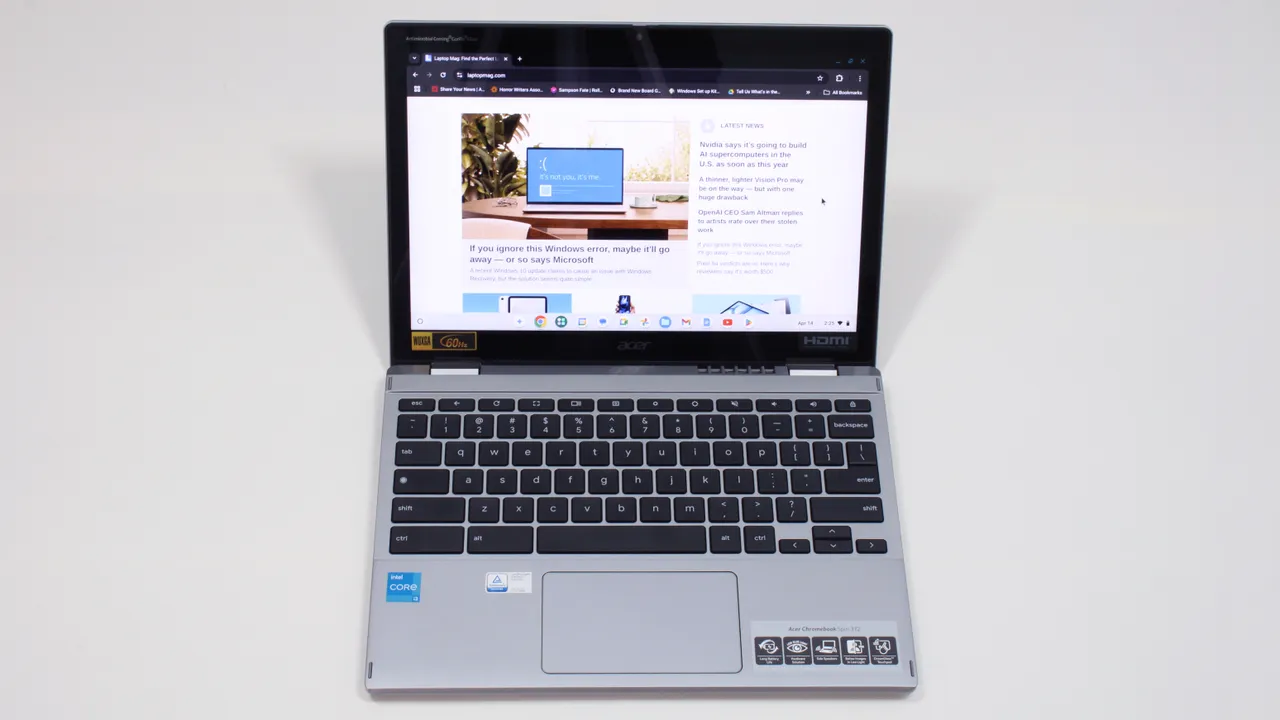
Now that 10-inch netbooks are de rigeur, PC makers are looking to bridge the gap, at least physically, between these secondary PCs and full-size notebooks, and the most obvious way to do that is by increasing the screen size to 11 or 12 inches. Somewhat surprisingly, ASUS is late to this game, having been beaten by Acer, Dell, Lenovo, and Samsung. However, that doesn't mean the $429 Eee PC 1101HA should be dismissed. On the contrary, this 11.6-inch netbook has much that we like about recent ASUS netbooks--including superb battery life and a stylish design--but its performance could be better.
Design
The largest member of ASUS' Seashell family, the Eee PC 1101HA is an up-sized version of the 1005HA. Though less svelte than the inch-thick1008HA, the 1101HA has similar curved panels and a sharp look. Gone, however, is the uniform body of the 1008HA; no plastic covers the edges or hides the ports. Its glossy lid, only available in black, is covered in a scratch-resistant Infusion Finish, which is far from fingerprint resistant, so you'll want to keep a cloth handy.
At 11.3 x 7.6 inches, the 1101HA is roughly an inch narrower than theLenovo IdeaPad S12, and has nearly the same footprint as theAcer Aspire One 751h. However, the 751h is thinner, staying at a constant 1 inch thick, whereas the 1101HA tapers from 1 inch at its front to 1.4 inches at its rear. Still, the 1101HA's six-cell battery is better concealed, and doesn't protrude like those on the 751h and S12.
Tipping the scales at 3 pounds (and 3.4 with its power adapter), the 1101HA is the same weight as the Aspire One 751h, and didn't put any strain on our shoulder as we carried it in a messenger bag.
Ports
On the left side of the 1101HA is a USB and VGA port. On the right side are a 3-in-1 memory card reader, an Ethernet port, two USB ports (bringing the USB total to three), and headphone and microphone jacks.
Keyboard and Touchpad

Click to enlarge
The Eee PC 1101HA includes the same comfortable, spacious keyboard that is found on the 1008HA. Unlike the Aspire One 751h, there are no spaces between the raised black matte keys, which are more akin to those on the IdeaPad S12. The keys provide nice, tactile feedback. In a slight regression to earlier Eee PCs, the right Shift key is undersized; however, it is in the correct position. ASUS should have made better use of available space; while the notebook is the same width as the Aspire One 751h, the 1101HA's keyboard is just 10.2 x 3.8 inches; on the Acer, it's 10.6 x 4.2 inches.

Click to enlarge

Click to enlarge
Similarly, ASUS could have used the larger chassis to incorporate a more spacious touchpad; as it is, the touchpad is the same size (2.5 x 1.5 inches) as that on the 1005HA. Also like its smaller brother and the 1008HA, the touchpad blends in with system's deck and is covered with small, braille-like dots. The pad had very little friction, and navigating the desktop didn't require much backtracking.
As with other Eee PCs, the touchpad also supports multitouch gestures; using two fingers to pinch the pad and zoom in on a Web page in Firefox was easy, and the image quickly rendered in its new size. The single mouse button was comfortable for making selections, although we prefer the Toshiba mini NB205's larger 3.1 x 1.6-inch pad with dedicated right and left buttons.
Display, Audio, and Webcam
The 11.6-inch, 1366 x 768-pixel resolution LED-backlit display on the 1101HA allows Web pages and windows to fit well on the screen. A 720p video ("Super Speedway") was crisp, and colors were bright. Unfortunately, playback was less than smooth (more on that below). Tilting the glossy screen back 45 degrees resulted in a slight glare; horizontal viewing angles were better. From afar, the glossiness of the black bezel made it look as if the screen were flush with the frame; up close, though, you can see that the bezel is slightly raised.
Above the display, a 1.3-megapixel webcam provided clear images in a Skype video chat. Our chat buddy was able to see fine details on our face, and saw little motion blur when we waved quickly. The speakers, located at the bottom front edge of the system, allowed us to hear his voice loud and clear from across the room. Similarly, when we listened to The Killers' "Shadowplay" streamed from Pandora, the sound was loud enough for a few people clustered nearby, but provided the usual netbook tinniness.
Performance
Configured with the same 1.33-GHz Intel Atom Z520 processor, 1GB of RAM, and Windows XP as the Acer Aspire One 751h, we didn't see much change in everyday performance or benchmarks on the 1101HA. We couldn't get PCMark05 (our standard performance benchmark for XP-based systems) to run, but on Geekbench, the 1101HA scored 707; that's nearly identical to the Aspire One 751h, which notched 697 on the same test. This performance carried over into our everyday computing tasks; writing this review in Microsoft Word and streaming video from Hulu with multiple tabs open didn't cause any system hang-ups.
The 1101HA comes with the Eee Super Hybrid Engine, which lets users change the clock speed on the fly. In Power Saving mode, the clock speed drops to 1 GHz; in Super Performance mode, it's increased to 1.73 GHz. The somewhat misleading High Performance mode keeps the clock speed at the rated 1.33 GHz.
The Intel GMA 500 integrated graphics chip with 253MB of shared memory delivered a score of 88 on 3DMark06, which was 8 points lower than the category average, but about 40 points below the 12-inch Samsung NC20 netbook. A downloaded high-definition 720p video clip ("Super Speedway") played back poorly. While audio was smooth and steady, video would stutter and freeze constantly.
We also transcoded a 5:05 MPEG-4 video clip (114MB) to the AVI format using Handbrake; the Eee PC 1101HA completed the task in 35 minutes flat, which is 11 seconds faster than the Aspire One 751h, but nearly 6 minutes slower than the netbook category average. The Lenovo IdeaPad S12 completed the test in 28:57--currently the fastest for netbooks of this size. Regardless, a dual-core notebook is a better investment if you'll be doing this type of activity often.
On our LAPTOP Transfer Test, in which we copy a 4.97GB mixed-media folder, the 1101HA's 160GB, 5,400-rpm Hitachi hard drive notched a score of 14.6 MBps, which is below the netbook average (15.1 MBps), but on a par with theSamsung NC20and Aspire One 751h. Once again, the IdeaPad S12 still leads the way with a transfer rate of 17.9 MBps. The 1101HA booted to Windows XP in 58 seconds, which is 4 seconds longer than the netbook average.
The system stayed cool while running our transcode test--the underside, the space between the G and H keys, and the touchpad never exceeded 86 degrees Fahrenheit. However, the fan located on the left edge was relatively noisy during extended use, and when the netbook was in Super Performance mode.
Battery Life
The 1101HA is built for endurance; like the 1005HA, its 5600-mAh, six-cell battery is rated for 63 Watt hours. On the LAPTOP Battery Test, which assesses endurance by surfing the Web until the battery dies, this netbook lasted 8 hours and 44 minutes, which is 90 minutes longer than the Aspire One 751h (7:08) and more than 2.5 hours longer than the six-cell netbook average of 6:14. Unlike the battery on the 1008HA, the 1101HA's can be removed or replaced.
Wireless Performance
The Eee PC 1101HA's 802.11b/g/n Wi-Fi card provides a solid connection for working on the Web. At 15 feet, its throughput of 23.7 Mbps was well above the netbook average of 19.5 Mbps; however, it dropped off at 50 feet, registering just 15.5 Mbps, which is slightly below average. However, streaming a 360p-resolution episode of 21 Jump Street from Hulu was slightly choppy at full screen, which only worsened when we opted for the higher-res 480p version.
Eee Docking Software

Click to enlarge
ASUS carried over its new Eee Docking bar (which debuted on the Eee PC 1005HA) to the 1101HA. Centered along the top of the desktop (though you can change its placement in the Settings menu), the pull-down dock provides one-click access to four categories of Eee-branded software.
The Eee @Vibe button launches ASUS' multimedia portal that contains Internet radio and TV stations; the software was not loaded on our unit, but clicking the button displayed a message that said "coming soon." An ASUS rep told us this feature should be available toward the end of August. Eee Sharing contains shortcuts to Data Sync (for syncing files with an external drive), EzMessenger (for transferring files between Eee PC netbooks) and Eee Storage (an online storage system), which provides 10GB of free online storage. Eee Xperience contains Eee Splendid (a tool for adjusting the colors on-screen) and Voice Command. The latter program wasn't loaded on our system, but it should let you open applications with voice prompts.
Lastly, Eee Tools contains parental controls, font resizing software, and the Eee docking settings menu. ASUS' standard Super Hybrid Engine software for over- or underclocking comes with the netbook, as does a 60-day trial of Microsoft Office Home and Student 2007, Microsoft Works, and Skype.
Green Testing
Thanks to its long battery life, the Eee PC 1101HA is the one of the most efficient netbooks we've tested. It took 3 hours and 8 minutes to fully recharge its battery; during that time, the 1101HA used an average of 33.9 watts, for a total of 6373.2 watts. Its LAPTOP Battery Efficiency Rating (total watts divided by battery life) of 12.2 watts per minute is second only to theHP Mini 5101and ASUS Eee PC 1008HA, which have ratings of 11.8 and 11.1 watts per minute, respectively. The 1101HA has yet to be rated by EPEAT (Electronic Product Environmental Assessment Tool).
Upgrade Options and Warranty

Click to enlarge
Those interested in increasing the RAM can easily remove the small door on the back of the 1101HA and add a 2GB stick of RAM. There's no upgrade panel for the hard drive, though intrepid users may be able to access it by removing the keyboard. ASUS backs this netbook with a standard one-year warranty and 24/7 toll-free tech support. To see howAsus fared in our annual tech support showdown, click here.
Verdict
There are now a handful of 11- and 12-inch netbooks for consumers who are looking for a bit more real estate for their eyes and hands. At $429, the ASUS Eee PC 1101HA is a compelling buy. While it's $50 more expensive than the Acer Aspire One 751h, it's $70 cheaper than the Lenovo IdeaPad S12 and the Samsung NC20. However, those latter two netbooks offer a performance advantage that can't be overlooked. But if all-day endurance is what you're after, then the 1101HA is a solid choice.
[flq:e54b931381b44e6990eb8e0fd82ee1bb]
ASUS Eee PC 1101HA Specs
| Bluetooth | Bluetooth 2.1 EDR |
| Brand | ASUS |
| CPU | 1.33-GHz Intel Atom Z520 |
| Card Slots | 3-1 card reader |
| Company Website | http://usa.asus.com |
| Display Size | 11.6 |
| Graphics Card | Intel GMA 500 |
| Hard Drive Size | 160GB |
| Hard Drive Speed | 5,400rpm |
| Hard Drive Type | SATA Hard Drive |
| Native Resolution | 1366x768 |
| Operating System | MS Windows XP Home |
| Ports (excluding USB) | Microphone, Kensington Lock, Headphone, Ethernet, VGA |
| RAM | 1GB |
| RAM Upgradable to | 2GB |
| Size | 11.3 x 7.6 x 1.4 inches |
| USB Ports | 3 |
| Video Memory | 253MB |
| Warranty/Support | One-year limited, six months for battery, 30-day Zero Bright Dot/24/7 toll-free phone |
| Weight | 3 pounds |
| Wi-Fi | 802.11b/g/n |