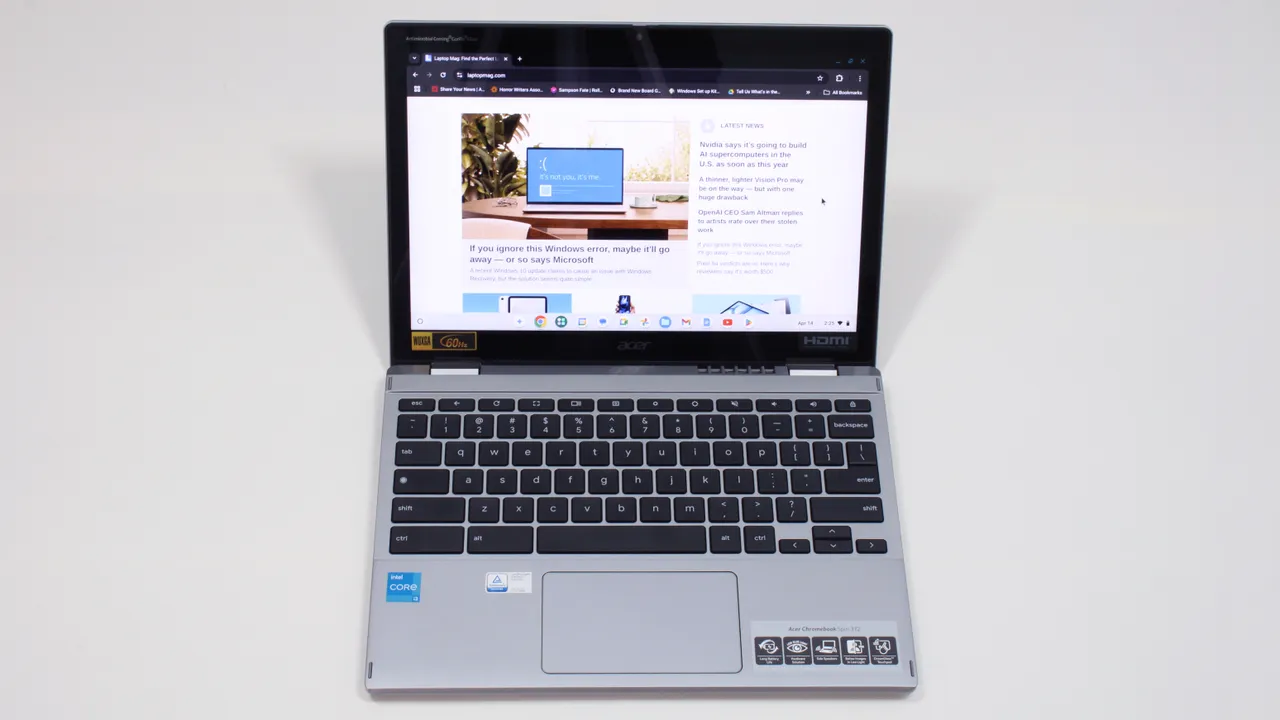
Laptop Mag Verdict
Lightweight design. Eight hours of battery life. Good-enough performance. What else would you want from a budget ultraportable?
Pros
- +
Thin, lightweight design
- +
Extra-long battery life
- +
Fast hard drive
- +
Excellent HD webcam
- +
Strong wireless range
Cons
- -
Lacks optical drive
- -
Stiff touch button
- -
Speakers not very loud
Why you can trust Laptop Mag Our expert reviewers spend hours testing and comparing products and services so you can choose the best for you. Find out more about how we test.
The Aspire Timeline 3810T is a flagship member of Acer's new Timeline series, which offers consumers inch-thin, long-lasting notebooks with starting prices well under a thousand dollars. It's part of a rapidly growing trend in notebooks that are smaller and cheaper than mainstream ones, but larger and pricier than netbooks. For $899 (starting at $599), the 13.3-inch 3810T outshines most value-priced notebooks with an outstanding eight hours of battery life, and an extremely slim profile. You also get a big, speedy 500GB hard drive, and performance that's more than good enough for everyday computing. If you can live without an optical drive, which might be a deal breaker for some, the Timeline 3810T is a great buy.
Super-thin Design
With the lid closed, the Timeline 3810T's matte gray, fingerprint-proof plastic lid is similar to the company's business-oriented TravelMate series. In contrast to the $899 Aspire 3935, which, for the same price, sports a more attractive golden brown brushed-metal chassis, and an integrated optical drive. On the other hand, the 3810T is significantly lighter at 3.6 pounds (vs. 4.2 for the 3935) and marginally thinner (0.9 inches at its thinnest point vs. 1.0 inches).
This machine is noMSI X340, which weighs 2.9 pounds, but it's still refreshingly light to carry. Overall, the matte gray-and-black color scheme is a bit conservative, but the keys' finish and island-style layout keep it current.
You won't find any multimedia controls, touch-sensitive or otherwise, on this notebook--just a strip of LED lights above the keyboard indicating Wi-Fi connectivity, BackUp Manager, battery power, and hard drive. A small button next to the touchpad deactivates it (a feature more commonly found on business notebooks, which have both a touchpad and a trackball in the center of the keyboard).
Keyboard and Touchpad
The arrangement of the 3810T's keys is unusual: they're closer together than a typical island layout (think Apple's MacBook line or any Sony VAIO notebook), but there's still enough space between them that they look, at first glance, like a more traditional keyboard. Nevertheless, our hands settled comfortably on the soft keys, and we made few typing errors as we surfed the Web, and responded to e-mail. We also warmed to the keys' low pitch, and their minimal sound.

Click to enlarge
Hands down, our least favorite feature is the 3810T's stiff single mouse button. We would have preferred two separate buttons. That said, the touchpad was large enough, and provided just the right amount of friction.
Display and Sound
The LED-backlit 13.3 display was exceptionally bright when we bumped the brightness to its maximum settings. Although the screen was washed out when we pushed the lid forward, we were able to comfortably watch from the sides, despite the glossy finish. The 1366 x 768 screen resolution (standard for a 16:9 13-inch notebook) was sufficient to watch a Saturday Night Live clip on Hulu at full screen.
Not surprisingly, given the notebook's size and price, the speakers were weak. When we watched clips online and streamed music from Slacker, the music and dialogue sounded distant, and never very loud. With music, in particular, bass and percussions in everything from MGMT to The White Stripes got lost in the tinny shuffle.
Ports and Webcam
Unlike most 13-inch notebooks, the Timeline 3810T has no optical drive. While it's true that you can download movies and software from the Web (instead of using DVDs or CD-ROMs), some users may prefer a DVD drive. We're of the opinion that you don't need one, unless you like to burn movies or back up to DVDs. Plus, the lack of an optical drive helps this notebook achieve its slim profile and light weight.
Otherwise, the 3810T has all the ports you could need: three USB ports, HDMI and VGA output, an Ethernet jack, headphone and mic ports, and a Kensington lock slot. It also has a 5-in-1 memory card reader. All of these openings are divided evenly between the two sides; none are on the back or the front.

Click to enlarge

Click to enlarge
The 720p webcam is one of the best we've tested on a notebook recently. While some laptops' 1.3-MP cameras struggle to produce smooth video at even VGA resolution, the 3810T's high-def video looked fluid, with little, if any, lag. Likewise, our still photos showed lots of detail. Our only gripes: the lighting was dim, and both our photos and videos had a subtle yellow cast to them.
Performance

Click to enlarge
Our Timeline 3810T configuration packed a 1.4-GHz Intel Core 2 Duo U9400 CPU, 4GB of RAM, and Windows Vista Home Premium (64-bit). This combination produced a score of 2,678 in PCMark Vantage, which measures application performance in Vista. That result is less than 100 points short of the ultraportable category average but nearly 200 points less than the Aspire 3935, which is equipped with a more powerful 2.0-GHz Core 2 Duo T7350 CPU.
The 500GB, 5,400-rpm drive on this notebook is fast: it transferred a 4.97GB mixed-media folder at a rate of 24.8 MBps. The average notebook in this weight class completes the same test at a rate of 19.7 MBps. The notebook took one minute to boot up, which is standard for a Vista machine.
While the 3810T's slow clock speed doesn't make much difference for everyday computing, intensive multimedia chores will prove challenging. For example, it took 22 minutes and 18 seconds to transcode a 5-minute-and-5-second MP4 clip to AVI using Handbrake. The average ultraportable, meanwhile, takes 16:41 seconds to complete the same task. Even the $899 MSI X340, which has a 1.4-GHz Intel Penryn Core 2 Solo SU3500 ULV processor and 2GB of RAM, took 18:12; and the Aspire 3935 took a brisk 7:56.
Graphics
When it comes to performance, graphics power is the 3810T's only glaring weakness. Its score of 698 on 3DMark06 falls short of the still-weak category average of 862, but is right in line with the X340's score of 643, which means you can forget about playing graphically demanding games. On Far Cry 2, this notebook managed just 3 frames per second with the resolution set to 1024 x 768, and 1 frame per second with the resolution cranked to its highest setting, 1366 x 768.
Despite its shortcomings, this machine comes with demo versions of 19 casual games (such as Puzzle Express and Parking Dash by Oberon Media) that are fun and easy to play. And we flew from the United States to Japan's Yokohama Beach in Google Earth with barely an onscreen blip.
Heat
In addition to long battery life, and its thin yet affordable design, the Timeline series promises to run cool, thanks to Acer's new Laminar Wall Jet technology. The result of a collaboration between Acer and Intel, this technology redirects air along the bottom of the notebook. We tested the heat while performing the same transcoding test described in the performance section.
While the temperatures ranged from cool to warm toward the beginning of this test, they rose from warm to hot by its end. The keyboard, touchpad, and bottom of the notebook were all 88 degrees to start (the bottom of the notebook got as cool as 82 degrees). Any temperature below 90 degrees is fine. But as time went on, the temperature in these three places rose to between 92 and 93 degrees (the bottom of the notebook even got as hot as 100 degrees). Despite these temperatures, though, both the keyboard and bottom felt more warm than hot.
Battery Life and Wi-Fi

Click to enlarge
The Timeline 3810T's extra-long battery life is one of the best reasons to buy it. The six-cell battery lasted an incredible 8 hours and 5 minutes on the LAPTOP battery test, whereas the average ultraportable lasts five hours and nine minutes, to be exact). However, it was about 40 minutes shy of the 8-cell battery on the X340, which lasted 8:48. Still, the Timeline also offers nearly double the endurance of the Aspire 3935.
Its Intel WiFi Link 5100 wireless-N radio delivered throughput of 20.0 Mbps and 17.5 Mbps at 15 and 50 feet, respectively. Again, that bests the category averages of 18.6 Mbps and 15.6 Mbps, respectively.
Configurations
In addition to our $899 configuration, the 3810T, you can also buy the 3810TZ, which costs just $599. But, the $300 dollar price drop comes with some pretty big compromises in terms of specs and performance. The 3810TZ has a 1.33-GHz Intel Pentium SU2700 CPU, a 320GB hard drive (by Hitachi, not Toshiba), and an Atheros wireless-G radio. It, too, however, has 4GB of RAM, and even claims a few more minutes of battery life than the $899 3810T.
Software and Warranty

Click to enlarge
The 3810T's bundled software and trialware include many of the usual suspects: Microsoft Office Home and Student 2007 (60-day trial) with a PowerPoint 2007 viewer, and the Compatibility Pack; Google Toolbar for Internet Explorer; McAfee Security Center; Windows Live Essentials; and Yahoo Toolbar.
We do welcome one piece of bundled software: Acer's BackUp Manager, which lets users designate a device (say, a portable hard drive) as their backup location, and allows them to schedule backups. Its neat UI lets users check boxes to back up videos, photos, music, pictures, browser favorites, e-mail, and Office files.
This system comes with a one-year limited parts-and-labor warranty, including 24/7, toll-free phone support. To find out how Acer's tech support fared, check out our annual Tech Support Showdown.
The Verdict
As long as you don't need an optical drive, we highly recommend the Timeline 3810T. In an increasingly crowded 13-inch notebook category, the Acer Aspire Timeline 3810T stands out, thanks to the combination of its low $899 price tag and astounding eight-plus hours of battery life. Consumers should also consider the $799 MSI X340, which doesn't perform as well, but is less expensive and has a longer battery life.
Of course, we'd never hesitate to recommend the $999 entry-level MacBook (whose specs have just been refreshed), which will surely offer more power; however, that machine is heavier, and it won't match the Timeline's endurance. In fact, we think the Timeline's biggest competition is the $899Aspire 3935, which sports an optical drive, and a more luxurious design, but has only a little more than 4 hours of battery life. Either way, you can't lose.
[flq:5b1d4fd801454b2182d594ad89b588cd]
Acer Timeline 3810T Specs
| Bluetooth | Bluetooth 2.0 |
| Brand | Acer |
| CPU | 1.4-GHz Intel Core 2 Duo SU9400 |
| Card Slots | 5-1 card reader |
| Company Website | http://us.acer.com |
| Display Size | 13.3 |
| Graphics Card | Intel GMA 4500MHD |
| Hard Drive Size | 500GB |
| Hard Drive Speed | 5,400rpm |
| Hard Drive Type | SATA Hard Drive |
| Native Resolution | 1366x768 |
| Operating System | MS Windows Vista Home Premium (64 bit) |
| Ports (excluding USB) | Kensington Lock, Headphone, HDMI, Ethernet, VGA, Microphone |
| RAM | 4GB |
| RAM Upgradable to | 4GB |
| Size | 12.7 x 9.0 x 1.3 inches |
| USB Ports | 3 |
| Video Memory | 64MB |
| Warranty/Support | One-year limited parts-and-labor/24/7 toll-free phone |
| Weight | 3.6 pounds |
| Wi-Fi | 802.11a/g/n |