Laptop Mag Verdict
This premium netbook, aimed at business users, offers switchable graphics, a huge hard drive, and a speedy instant-on OS.
Reasons to buy
- +
Sleek design
- +
Powerful graphics performance
- +
Big hard drive for a netbook
- +
Instant-on OS boots quickly
- +
Smart facial-recognition software
Reasons to avoid
- -
Pricey
- -
Relatively heavy
- -
Mediocre battery life
- -
Must reboot to switch graphics cards
Why you can trust Laptop Mag Our expert reviewers spend hours testing and comparing products and services so you can choose the best for you. Find out more about how we test.
As netbook manufacturers flirt with larger screen sizes, and generally raise the bar for performance, the definition of a netbook is constantly evolving. The ASUS N10J-A2 is the latest to break--or at least stretch--the mold. This $799 system offers a business-friendly design and port selection, along with switchable graphics, face detection, and several upgrades to the identically designedN10Jc($649), including a bigger 320GB hard drive (up from 160GB), 2GB of RAM (formerly 1GB), and Windows Vista Business. Its relative heft and less-than-stellar battery life are strikes against, but if you can live with a 10-inch display, the N10J-A2's overall performance and design make it a good alternative to traditional ultraportables that cost considerably more.
Design
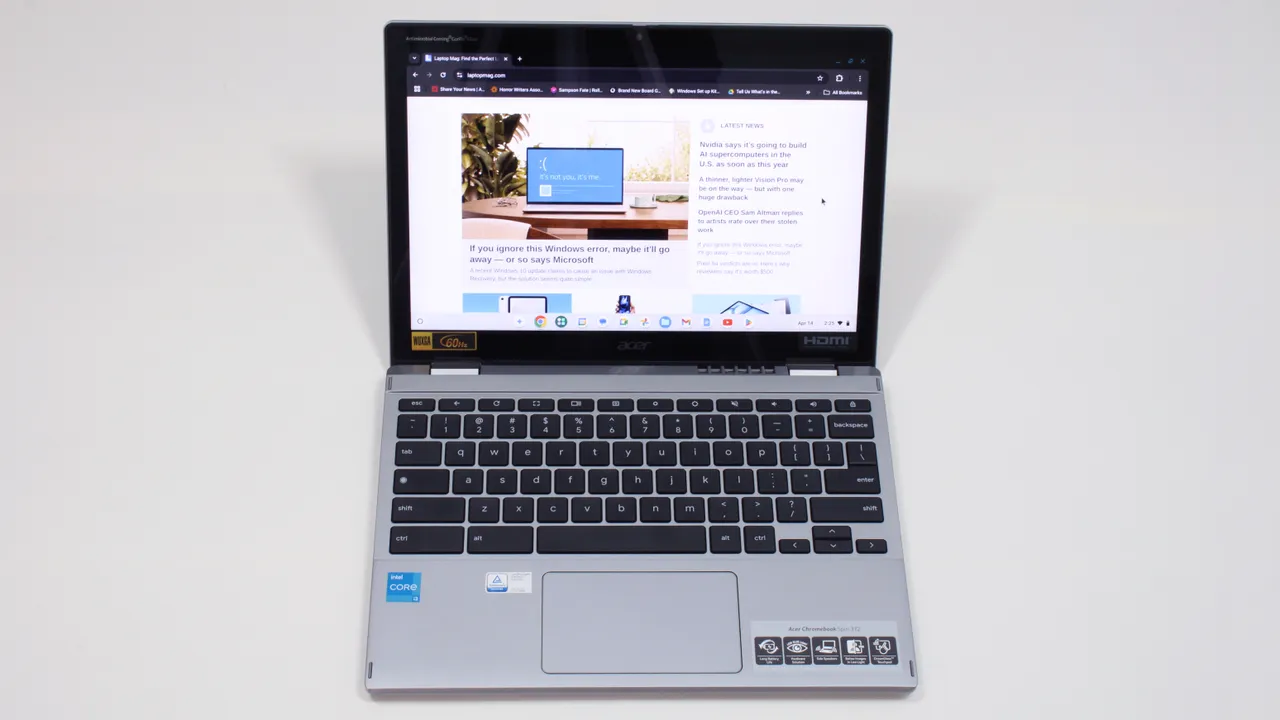
Despite its 10.2-inch screen, the N10J-A2 doesn't look like a typical netbook. Beginning with its glossy taupe lid, silver hinge, and subtly stamped logo, it has a more refined aesthetic than the plastic chassis belonging to other netbooks. To be fair, its hefty shape also makes it look more like a full-size notebook: at 10.8 x 7.6 x 1.4 inches and 3.4 pounds, it's still compact enough to carry in the crook of your arm, but plenty of lighter netbooks are out there, even ones with six-cell batteries (theHP Mini 2140, another business-oriented netbook, weighs 3 pounds).
The glossy taupe continues on the inside, covering the palm rest and even the trackpad and touch buttons. Above the keyboard are buttons for toggling between high-performance and battery-saving modes, turning the computer on, and launching a draggable zoom box that can magnify on-screen text up to three times. The same button that toggles performance modes also boots the N10J-A2 into Express Gate, the instant-on OS (more on that later).
Keyboard and Touchpad
The spacious keyboard on the N10J-A2 is among the better ones we've used on a netbook. The panel is firm, with no flex, and the keys are nicely proportioned; however, as with the N10Jc we tested, the right Shift key is shrunken, which may annoy touch typists. We prefer the layouts on the HP Mini 1000 and Mini 2140, as well as theSamsung NC10. On the whole, typing was comfortable, but we noticed that we made less errors when we used theASUS Eee PC 1000HE, whose island keyboard we mastered immediately.
The large, 2.8 x 1.7-inch touchpad is as hard and smooth as the chassis. A scroll panel runs down the right side of the touchpad, but it felt overly sensitive. The metal buttons are roomy, quiet, and easy to press. Nestled between them is a fingerprint reader. Although mastering the finger swipe took about ten tries, we had no problems thereafter.

Click to enlarge
Display and Audio
The 10.2-inch display has a thick, one-inch bezel. Clips from Saturday Night Live on Hulu.com looked bright. The 1024 x 600-pixel resolution was sufficient; we didn't have to do any horizontal scrolling, and did less vertical scrolling than with netbooks whose resolution is 1024 x 576. The glossy finish didn't stop us from enjoying comfortable viewing angles when dipping the screen forward and watching from the side (though severe 180-degree viewing angles were a stretch).
The N10J-A2's Altec Lansing speakers produced sound that was louder than your average netbook's, but still not quite what you'd expect from a larger notebook. The quality, however, was pleasant; it wasn't too tinny when we streamed Internet radio.
Ports and Webcam

Click to enlarge
The N10J-A2 has plenty of ports and slots: three USB 2.0 ports, HDMI and VGA output, an Ethernet jack, headphone and mic ports, an 8-in-1 memory card reader, and a welcome ExpressCard slot for plugging in a low-profile mobile broadband card. The HDMI port is rare among netbooks, allowing you to output audio and video to an external display with a single cable.
The 1.3-megapixel webcam comes with SmartLogon face-detection software. Configuring our login was easy; we just positioned our face in front of the webcam for a few seconds while the webcam captured a series of frames. The next time we logged into our account, the computer recognized us within seconds on its first try.

Click to enlarge

Click to enlarge
Express Gate
We were impressed by how quickly Express Gate loaded: it took just 8 seconds to boot, and 3 for the browser to load. The main screen has large, colorful icons denoting the Web browser, music, photos, online games, chat, and Skype. Even when you choose an app, such as the browser, the remaining icons will still line the bottom of the screen, so you can switch gears quickly.
Like Lenovo's Quick Start, which is also built on top of Splashtop, Express Gate's browser is a pared-down version of Firefox; the same keyboard shortcuts apply, and you can watch clips on YouTube, but you can't install add-ons. The chat service is Pidgin, a multi-client program included with many Linux-powered netbooks.
When you're done, you can press the power button icon to shut down or begin loading Windows.
Performance

Click to enlarge
Like many other netbooks, the N10J-A2 is powered by a 1.6-GHz Intel Atom N270 CPU. However, it has Windows Vista Business, a rarity in netbooks, with 2GB of RAM to match. (The N10Jc had the same CPU but ran Windows XP Home and included 1GB of RAM.)
In addition to integrated and discrete graphics, the N10J-A2 has high-performance and battery-saving modes, which you can change by pressing the corresponding button above the keyboard. When it came to our usual performance and graphics benchmarks, we ran them four times to take into account every combination of graphics card and performance mode.
In all but one of the testing scenarios (integrated graphics in battery-saving mode) this system exceeded the netbook category average in PCMark Vantage (1,076): it notched 1,260 and 1,256 with discrete graphics (in high-performance and battery-saving mode, respectively) and 1,090 and 681 with integrated graphics.
Indeed, the N10J-A2 felt fast during hands-on testing. Launch Internet Explorer and Adobe Reader took just 2 seconds each, and Windows Media Player took 1 second. As we surfed the Web with multiple tabs open, this machine had no problem keeping up as we clicked from tab to tab, reading e-mails, and watching clips on YouTube.
On the other hand, it took a sluggish 1 minute and 15 seconds for the N10J-A2 to boot, which is 10 seconds slower than the N10Jc, which had XP Home. On the LAPTOP Transfer Test (copying a 4.97GB folder of mixed media), the N10J-A2 took 6:07. That works out to 13.9 MBps, or just slightly above the 13.8-MBps average.
Switchable Graphics

Click to enlarge
Like the N10Jc before it, the N10J-A2 has dual integrated and discrete graphics cards (Intel GMA 950 and an Nvidia GeForce 9300M GS with 256MB dedicated memory). Users can toggle the two by flipping the switch on the side of the system. Unfortunately, once you've flipped the switch, a reboot is required.
Across the board, the N10J-A2 steamrolls other netbooks in the graphics arena. With discrete graphics enabled, it scored 4,646 and 3,852 on 3DMark03 in high-performance and battery-saving mode, respectively. With integrated graphics, it scored 608 and 353. The category average for this test is a mere 612. So, unless you enable the integrated graphics card and keep the netbook in battery-saving mode, you're going to see above-average, if not screaming, gaming performance.
The N10J-A2 even fared well in more graphically demanding situations. In 3DMark06, which simulates more sophisticated games, it scored 1,566 and 1,056 with discrete graphics, and 145 and 83 with integrated; the category average is 91 (see full graphics tests below and on our specs page).
That said, this netbook may not be best for graphically demanding games. Even with discrete graphics enabled, N10J-A2 managed only 26 frames per second in F.E.A.R. on autodetect settings (800 x 600-pixel resolution) and 21 frames per second on maximum settings (1024 x 600-pixel resolution). With integrated graphics, these numbers dropped to 17 and 11 frames per second, respectively.
When we played Far Cry 2, the N10J-A2 eked out a slow 11.0 frames per second at 800 x 600-pixel resolution and 11.6 at 1024 x 600.
| Graphics and Power Mode | Discrete, High Performance | Discrete, Battery-Saving | Integrated, High Performance | Integrated, Battery-Saving |
| PC Mark Vantage | 1,260 | 1,256 | 1,090 | 681 |
| 3DMark03 | 4,646 | 3,852 | 608 | 353 |
| 3DMark06 | 1,566 | 1,056 | 145 | 83 |
Battery Life and Wi-Fi
The N10J-A2's six-cell battery lasted 4 hours and 11 minutes with discrete graphics enabled in the LAPTOP Battery Test (continuous Web surfing over Wi-Fi), and 4:36 with integrated graphics enabled. That's not bad, but this endurance falls short of other netbooks with six-cell batteries, which have an average runtime of 5:43.
On the plus side, this netbook's 802.11b/g/n radio delivered strong wireless scores: 20.4 Mbps and 18.7 Mbps at 15 and 50 feet, respectively (the category average is 18.7 and 15.1 Mbps). The N10J-A2 also has an integrated Bluetooth connection.
Software and Warranty

Click to enlarge
The N10J-A2 comes with a fair share of ASUS-branded software: LifeFrame 3, Live Update, Power4Gear Hybrid, SmartLogon, Splendid Video Enhancement Technology, Virtual Camera, Zoom In, and DVD; also bundled are CyberLink LabelPrint, CyberLink Power2Go, and Microsoft Office 2007 (60-day trial). The company covers this netbook with a generous warranty: two years parts-and-labor, including one year of accidental damage support, with toll-free, 24/7 phone support.
Verdict
The $799 ASUS N10J-A2 is a premium netbook that stands out from the competition for its very good graphics performance, large 320GB hard drive, and speedy Express Gate OS. For business users, we recommend the HP Mini 2140 ($529) over this netbook because of its much longer battery life and superior keyboard. Also, the $399 Eee PC 1000HE, which lasts over 7 hours on a charge, offers better bang for your buck. But if you want a lightweight system with plenty of power, the N10J-A2 is a tempting choice.
ASUS N10J-A2 Specs
| Bluetooth | Bluetooth 2.0 |
| Brand | ASUS |
| CPU | 1.6-GHz Intel Atom N270 |
| Card Slots | 8-1 card reader |
| Company Website | http://usa.asus.com |
| Display Size | 10.2 |
| Graphics Card | Intel GMA 950: Nvidia GeForce 9300M GS |
| Hard Drive Size | 320GB |
| Hard Drive Speed | 5,400rpm |
| Hard Drive Type | SATA Hard Drive |
| Native Resolution | 1024x600 |
| Operating System | MS Windows Vista Business |
| Ports (excluding USB) | VGA, Microphone, Headphone, HDMI, Ethernet |
| RAM | 2GB |
| RAM Upgradable to | 2GB |
| Size | 10.8 x 7.6 x 1.4 inches |
| USB Ports | 3 |
| Video Memory | 256MB |
| Warranty/Support | Two-year parts-and-labor, one-year accidental damage/24/7 toll-free phone |
| Weight | 3.4 pounds |
| Wi-Fi | 802.11b/g/n |