Laptop Mag Verdict
This sleek ultraportable offers better performance than netbooks and nearly nine hours of battery life.
Pros
- +
Slim, lightweight design
- +
Comfortable keyboard
- +
Excellent endurance
- +
HDMI output
Cons
- -
Low graphics scores
- -
Left side runs very warm
- -
Limited tech support hours
Why you can trust Laptop Mag Our expert reviewers spend hours testing and comparing products and services so you can choose the best for you. Find out more about how we test.
It looks like a netbook, but the Acer Aspire 1810T doesn't act like one. In fact, this 11-inch ultraportable offers very good performance for its size, while still offering all-day battery life. That's because this machine is loaded with a relatively powerful dual-core Intel Ulta-Low Voltage (ULV) processor--not the meager Atom CPU. The $599 asking price is somewhat steep compared to netbooks, but those looking for something with considerably more gusto--and nearly 9 hours of battery life--can't go wrong with this system.
Design
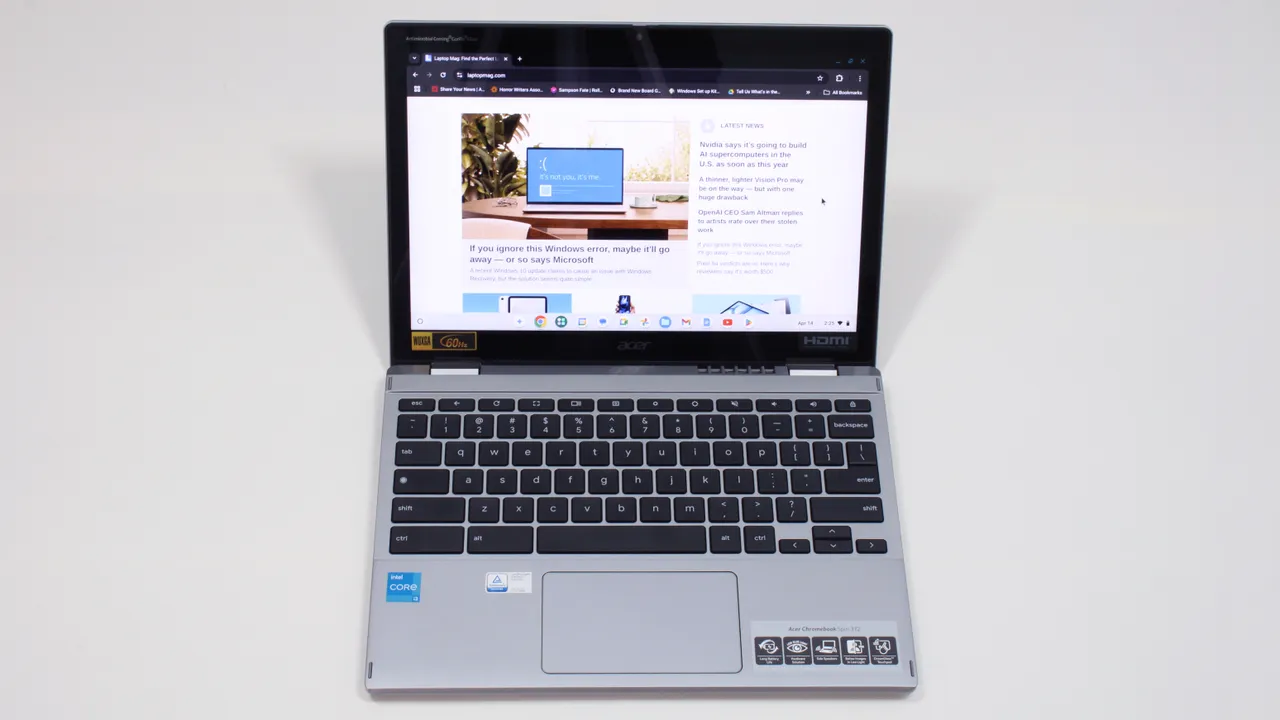
From the outside, the Acer Aspire 1810T is almost identical in looks to the Acer Aspire One 751h netbook; at 11.2 x 8.0 x 1.2 inches and 3.2 pounds, it's practically the same size and weight. It has a glossy, sapphire blue lid with Acer's metal logo impressed in the lower corner of the lid, which picks up fingerprints fairly easily. This same color extends to the deck, which is offset by the matte black keyboard and glossy black bezel.
One key difference between the 751h and the 1810T is that the latter's six-cell battery does not bulge out the back; instead, it bumps out of the bottom, tilting the system at a slight downward angle towards the user.
Keyboard and Touchpad
Like most other new Acer notebooks, the 1810T's keyboard has flat, non-chamfered plastic keys that have a slightly textured feel. The layout is 92 percent of full size--larger than that found on the HP Mini 311--and we appreciate that the large right Shift key is in the proper place. We were typing at full speed in no time at all.

Click to enlarge
The touchpad sits flush with the deck, and is only demarcated by two lines on either side. At 2.6 x 1.5 inches, it's decently sized, and slightly larger than the 751h's 2.5 x 1.6-inch touchpad; we liked that it offered little resistance as we moved our finger across it. (Toshiba's mini NB205 still offers the largest touchpad around, at 3.1 x 1.6 inches.) The two accompanying silver buttons proved nice and crisp, an improvement over the 751h's single bar.
Display and Sound
Like other notebooks with 11.6-inch displays, the 1810T's has a resolution of 1366 x 768. Those extra vertical pixels mean less scrolling when viewing Web pages or documents, and that you can view high-definition content in 1080p.
The screen is quite bright. When we watched an episode of The Simpsons on Hulu, we enjoyed pleasant colors and good viewing angles even from oblique side views; it was as if we were watching the show on our TV. While the glossy finish limited our view to the front, we were still able to make out the clip when we dipped the lid forward slightly.
The 1810T's speakers, located on the underside of the front lip, were fine for a small notebook, but their placement caused sound to be muffled while the system was in our lap; when the notebook was placed on a hard surface, such as a coffee table, sound was more amplified as it reflected upward.
Ports and Webcam
On the right side of the 1810T is an Ethernet port, a Kensington lock slot, two USB ports, headphone and mic ports, and a 5-in-1 memory card reader. On the left-hand side is a VGA port, a third USB port, and HDMI output (something the Atom-powered 751h lacks). Underneath the front lip are well-concealed switches to activate Wi-Fi and Bluetooth.

Click to enlarge

Click to enlarge
The 1.3-megapixel webcam mounted above the display was acceptable; colors, such as a dark green shirt, were reproduced well in a video call over Skype. Our caller also said that the image was sufficiently lighted, and that motion blur only became an issue if we waved our hand vigorously.
Performance

Click to enlarge
While we were underwhelmed by the 1.33-GHz Intel Atom Z520 processor in the Aspire One 751h, we were much more satisfied with the 1.3-GHz Intel Pentium SU7300 CPU in the 1810T. The notebook (aided by 4GB of RAM) was able to notch a score of 2,938 in PCMark Vantage. That's nearly 200 points above the ultraportable average, and the most powerful among 11.6-inch notebooks. This was one area where the 1810T outperformed the HP Mini 311's Atom processor; the 1810T scored 1,605 on Geekbench, almost twice that of the 311.
The 1810T's 5,400-rpm, 320GB hard drive booted Windows 7 Home Premium in a fairly snappy 67 seconds, and was equally quick during our LAPTOP Transfer Test. It duplicated 4.97GB of multimedia files at a rate of 23.1 MBps, about 3 MBps faster than the ultraportable average.
The processor also did well on our transcoding test (converting a 114MB MPEG-4 file to AVI using HandBrake). It took 11 minutes and 24 seconds; that's about 3 minutes faster than the ultraportable average, and over 10 minutes faster than the MSI Wind12 U210. On the other hand, the Mini 311 transcoded the same clip in almost half the time (6:14) with vReveal, a program that's optimized for Nvidia's GPU.
In everyday computing--surfing the Web, video chatting, playing Spore, composing a document in Microsoft Word--the 1810T performed well, never choking on any of the aforementioned tasks. Watching a full screen Hulu video (from Cougar Town) was smooth; the average frame rate hovered around 20 frames per second.
Graphics and Video Performance
Predictably, graphics scores were weak; the Intel GMA 4500MHD GPU mustered only 594 in 3DMark06. While that's well above the netbook average (99), it's about 300 points below the ultraportable average. Moreover, the HP Mini 311, which uses an Nvidia Ion LE GPU, scored more than double on the same test. Playing Spore with the resolution set to 1024 x 768 and graphics set to medium, we averaged 18 fps. By comparison, the Mini 311 saw 28 fps with a resolution of 1088 x 612 and effects on medium.
We decided to further test this machine's multimedia mettle by outputting high-def MPEG-4 videos to a 1080p Samsung 32-inch LCD television via HDMI. With its resolution set to 1920 x 1080, a 1080p file (from Cloudy with a Chance of Meatballs) played smoothly for the most part, but we did notice brief pauses now and then; the HP Mini 311 played back the video more smoothly. However, it's interesting to note that the 1810T loaded the file in just 10 seconds, where it took the 311 half a minute.
Battery Life and Wi-Fi
One of the things that most impressed us about the 1810T was its endurance. The six-cell, 5600-mAh battery lasted 8 hours and 45 minutes on the LAPTOP Battery Test (Web surfing via Wi-Fi). That's over three and a half hours longer than the ultraportable average, three hours and two minutes longer than the HP Mini 311, and nearly the same as the ASUS Eee PC 1101HA (8:44), an 11.6-inch netbook that offers far weaker performance.
The 802.11b/g/draft-n Wi-Fi throughput of 19.3 Mbps at 15 feet from our access point was just about in line with the ultraportable category average; at 50 feet, it performed slightly better, achieving 17.9 Mbps (where the average is just 17.0 Mbps).
While running our transcode test, we measured the temperature of the 1810T. The touchpad and the area between the G and H keys stayed below 90 degrees Fahrenheit, but the left side of the undercarriage got as hot as 100 degrees.
Greenness

Click to enlarge
Despite its additional muscle compared to a traditional netbook, the 1810T sips electricity. It took 5 hours and 29 minutes to fully recharge, and used a total of 9146.2 watts during that time. For the LAPTOP Battery Efficiency Rating (total watts divided by runtime; lower is better), the 1810T scored 17.4. That's well below the ultraportable average (20.6), and even lower than the netbook average (18.0).
Configurations
Acer offers a single hardware configuration of the 1810T, but consumers can opt for either a Ruby Red (1410-8913) or Diamond Black (1410-8804) model. Modders will also find the hard drive and memory slots easily accessible from removable panels on the underside.
Software and Warranty
Acer includes a spate of its own apps with the 1810T (which includes GameZone and Crystal Eye webcam software), as well as CyberLink PowerDVD, Google Desktop and Toolbar, a 30-day trial of McAfee Security Center, a 60-day trial of Microsoft Office 2007, and Microsoft Works.

Click to enlargeThe system is covered by a one-year warranty, which includes toll-free phone support Mon--Fri 8 a.m. to 10 p.m., Sat 9 a.m. to 7 p.m., and Sun 10 a.m. to 6 p.m. Check out Acer's performance in our annual Tech Support Showdown to see how the manufacturer stacks up against the competition.
Verdict
In the $599 Aspire 1810T, Acer has found a platform where Intel's ULV processor makes the most sense. In an 11.6-inch system, it provides a marked improvement over Atom chips without sacrificing endurance. However, in choosing between this system and an Ion-powered netbook like the HP Mini 311, you'll have to decide what's more important: graphics power, or CPU and battery performance. If you're willing to pay a $200 premium over the typical netbook, the 1810T's extra muscle, slick design, comfortable keyboard, and all-day battery life make it well worth the money.
Acer Aspire Timeline 1810T Specs
| Brand | Acer |
| CPU | 1.3-GHz Intel Pentium SU7300 |
| Card Slots | 5-1 card reader |
| Company Website | http://www.acer.com/us |
| Display Size | 11.6 |
| Graphics Card | Intel GMA 4500MHD |
| Hard Drive Size | 320GB |
| Hard Drive Speed | 5,400rpm |
| Hard Drive Type | SATA Hard Drive |
| Native Resolution | 1366x768 |
| Operating System | MS Windows 7 Home Premium |
| Optical Drive Speed | 8X |
| Ports (excluding USB) | Kensington Lock, Headphone, HDMI, Ethernet, VGA, Microphone |
| RAM | 4GB |
| RAM Upgradable to | 4GB |
| Size | 11.2 x 8.0 x 1.2 inches |
| USB Ports | 3 |
| Video Memory | 132MB |
| Warranty/Support | One-year limited/Mon--Fri 8 a.m. to 10 p.m., Sat 9 a.m. to 7 p.m., Sun 10 a.m. to 6 p.m. toll-free phone (EST) |
| Weight | 3.2 pounds |
| Wi-Fi | 802.11b/g/draft-n |