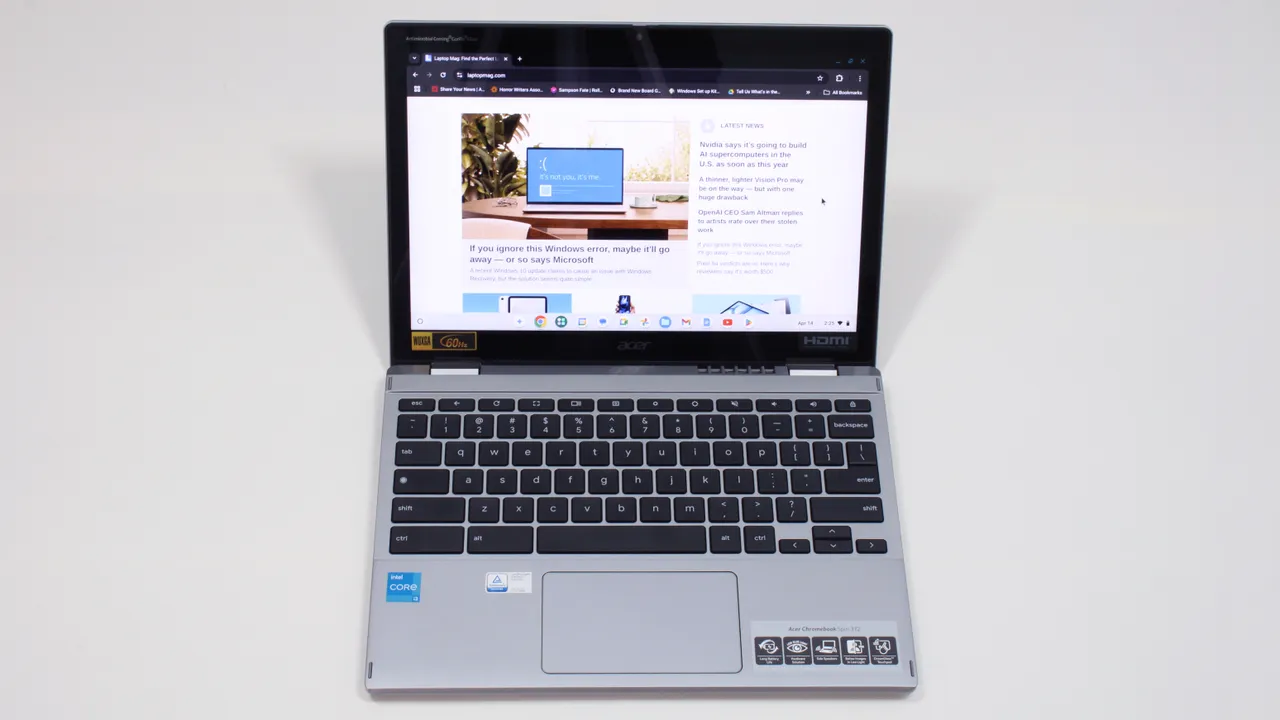
Laptop Mag Verdict
Samsung's sharp-looking netbook offers snappy Windows 7 performance, good ergonomics, and over 6 hours of battery life.
Pros
- +
Excellent keyboard and touchpad
- +
Bright and colorful matte screen
- +
Above average performance
- +
Good sound quality
- +
USB port charges gadgets with system off
Cons
- -
Glossy lid smudges easily
- -
Narrow touchpad button
- -
Inserted SD Cards protrude from slot
- -
Annoying trialware pop-ups
Why you can trust Laptop Mag Our expert reviewers spend hours testing and comparing products and services so you can choose the best for you. Find out more about how we test.
Last year, Samsung entered the netbook market with a strong contender in the NC10. This system impressed us with its sturdy and comfortable keyboard, good performance, and 6.5 hours of battery life. Now, the company is replacing the venerable NC10 with the $399 N140, an update that includes a more powerful Atom processor, Windows 7 Starter Edition, a larger 250GB hard drive, and a snazzier design. Are all of these improvements enough to keep up with the competition?
Design
The 10.3 x 7.3 x 1.2-inch N140 retains many of the design aspects we liked in the NC10. The glossy lid comes in two colors--an elegant Burgundy (as on our review unit) or Sapphire Blue--but it attracts fingerprints easily. Instead of the red stripe outlining the edge of the deck as on the N110, there's now a silver strip; another thin silver strip border outlines the touchpad. Though the lid is glossy, the plastic surrounding the display, keyboard, and touchpad is (thankfully) matte.
One change from the N110 is the placement of the power button. Instead of the button being integrated into the hinge, Samsung opted to place it on the front lip of the system, which we think is harder to reach. It's also not a button, but a sliding switch. Underneath, the six-cell battery lifts the unit up about a quarter of an inch, giving it a bit of an incline.
Samsung's N130, which is $50 less, shares many of the N140's features and build, including the keyboard, touchpad, and power switch. However, the chassis on the N130 lacks the more elegant lid and and silver detailing.
Heat
While writing this review and watching video with the N140, we never noticed excessive heat coming from the system. Upon leaving the netbook idle for five minutes, we measured temperatures on the touchpad and underside at 90.0 and 90.5 degrees Fahrenheit. After playing a Hulu video for 15 minutes, the touchpad reached only 93.0 degrees; the space between the G and H keys got to 90.0 degrees, and the underside notched 95.5, which was barely noticeable.
Keyboard and Touchpad

Click to enlarge
We're happy to see that the N140's keyboard is the same as the one found on the NC10 and N110, from key size and placement to spring and travel. At 93 percent of full size, it's comfortable to type on, and we noticed no flex.

Click to enlargeThe 2.5 x 1.4-inch touchpad is slightly wider than the N110's, and has just a touch of friction. It was large and responsive enough that we didn't have to pick up our finger too often when moving the cursor across the screen. A single mouse bar sits underneath the touchpad; while it was responsive, we found it to be too narrow. (In general we prefer that a netbook or notebook have two distinct touchpad buttons.)
Display and Audio
We were pleased to see that the 10.1-inch, 1024 x 600-pixel WSVGA display is matte and not glossy like that of the N110. Colors were bright and blacks deep. We were able to watch the dark scenes from Torchwood: Children of Earth under bright fluorescent lighting without an issue. Both horizontal and vertical viewing angles are good; even when we tilted the display all the way back to 45 degrees, we didn't encounter much distortion. Three people can sit together and watch video on the screen without trouble.
Audio quality was surprisingly good for a netbook thanks to the inclusion of SRS Sound software. The Realtek high definition speakers, located under the front of the unit, produced slightly tinny but satisfying audio. Even with the volume at 50 percent, we could still hear music clearly with a high-power fan running in a small room. The bass line in Superchick's "One Girl Revolution" didn't stand out as much as we'd like, but it was present.
Adjusting the equalizer via the SRS Sound settings resulted in richer audio that was good enough for watching Hulu and playing music while we wrote this review. Aside from the design, this is one of the greatest differences between the N140 and the N130, which lacks SRS as well as stereo speakers.
Ports and Webcam
The N140 has a standard array of ports: Ethernet, VGA, headphone, mic and one USB on the left; the power and remaining two USB ports on the right. The USB port on the left is a chargeable USB, meaning it will provide power to devices plugged into it even when the N140 is off. Users have the option to deactivate this feature; the utility is found in the Samsung folder in the Start menu.

Click to enlarge

Click to enlarge
The 3-in-1 memory card reader sits at the front of the unit next to the power switch. When we inserted an SD Card in the front slot we noticed that it stuck out half an inch. SD Cards never sat flush with the NC10 or N110 either, but they didn't stick out as much as they do on the N140. Also, the reader isn't spring-loaded, so the card felt less secure in the slot.
Above the display sits a 0.3-MP webcam. The bundled software, CyberLink's YouCam, allows users to apply fun effects to video or still images, and includes one-button uploads to YouTube. Images captured looked a little dark even in good lighting--not a surprise for a webcam of this quality. When chatting in Skype our friend reported that the image was good, if a bit yellow. Unfortunately, we noticed some blur whenever we moved.
Performance
The 1.66-GHz Intel Atom N280 CPU and 1GB of RAM delivered a strong score of 887 on Geekbench, which measures overall performance. This is more than 50 points above the average netbook, and beats out the Toshiba mini NB205-N330BL and Nokia Booklet 3G (805 and 787, respectively), two netbooks that both run Windows 7. While multitasking in Windows 7 Starter we switched between GIMP, Google Chrome (with up to 8 tabs open), Microsoft Word, and Windows Media Player without experiencing lag.
The 5,400-rpm, 250GB hard drive also performed well. Transferring a 4.97GB mixed media folder took 4 minutes and 13 seconds, for a file transfer rate of 20.1 MBps. This score is well above the 15.4 MBps average, and bested almost every other Windows 7 netbook except the Sony VAIO X (27.2 MBps) and the ASUS Eee PC 1008HA Seashell (22.2 MBps). The N140 also outshone the older Samsung N110 (16.1 MBps).
We were content with the N140's boot time of 54 seconds, which is 3 seconds faster than the netbook average. Among those running Windows 7, it's only beaten by the Sony VAIO X (50 seconds), a system that costs $1,100 more.
When we transcoded a 114MB MPEG-4 video clip to AVI using HandBrake, it took 29 minutes and 14 seconds--about 30 seconds under the category average (29:42). This showing comes in well under the Nokia Booklet 3G (32:09). (Lower is better.)
Intel's integrated GMA 950 graphics chip earned the N140 a 3DMark06 score of 147. This falls short of the average netbook (160) and the ASUS Eee PC 1008HA (151), but surpasses the N110 (90) and the Toshiba mini NB205 (112).
A standard definition video clip of Stargate SG-1 played smoothly, as did video on Hulu and YouTube. Full-screen Hulu clips stuttered a bit, which par for the course with netbooks.
Wi-Fi and Battery Life

Click to enlarge
The N140's Wi-Fi throughput was somewhat disappointing. At 15 feet from the router, this netbook's 802.11b/g/n wireless card delivered a data rate of 16.4 Mbps, well below the average score of 20.8 Mbps. This is the lowest 15-foot score earned by all of the current Windows 7 netbooks, including the Hercules eCAFE EC-1000W (22.1 Mbps) and the Nokia Booklet 3G (18.1 Mbps). Fifty feet from the router, the N140's throughput only dipped to 15.4 Mbps, but that's still below average (17.1 Mbps).
On the LAPTOP Battery Test, the N140 lasted 6 hours and 32 minutes. This is enough for nearly a full workday of computing, and it's better than the six-cell average of 6:18 and the Eee PC 1008HA's endurance (4:43). However, the Samsung N110 lasted almost an hour longer on a charge, and the N140 is nearly two hours behind the Toshiba mini NB205 (8:51). We wish Samsung gave the N140 the same high-capacity 5900-mAh battery as the N110.
Software
Samsung opted for Windows 7 Starter Edition for the N140, which is a lightweight version of Microsoft's latest operating system. Though we suspect many users can live with the limitations versus Premium Home Edition--no Aero Glass interface, Windows Media Center, remote media streaming, or desktop wallpaper options--they detract from the appeal of the Windows 7 experience.
Samsung preloads the N140 with a large suite of branded apps and utilities. Aside from the aforementioned CyberLink YouCam and Chargeable USB utility, the netbook also includes management utilities for resolution, display (including hot keys to rotate 90 and 180 degrees, which is useful if you're using the N140 as an eBook reader), networks, and power profiles. The Battery Life Extender caps the battery's charge at 80 percent to prolong its life for systems that are often kept plugged in. Samsung Update Plus automatically keeps all these apps up to date.
Unfortunately, the N140 comes with quite a bit of trialware, which meant many annoying pop-ups not only just after startup but also in the middle of writing this review. McAfee Internet Security was the biggest culprit, and the FailSafe window was all the more annoying because we couldn't move our mouse beyond its borders until we clicked a button to dismiss the 60-day trial offer. There are also 60-day trials of Microsoft Office 2007 and AnyPC (for remote access to other computers).
Additionally, Samsung includes a casual gaming portal and the Windows Live suite of programs.
Configurations and Warranty

Click to enlarge
The N140 is currently available in just one configuration with two model numbers: The N140-14B indicates the Sapphire Blue lid and the N140-14R indicates Burgundy. Though you can't order the N140 with more than 1GB of RAM, the slot is easily accessible from the underside.
Samsung offers a one-year standard parts-and-labor warranty and 24/7 toll-free technical support.
Verdict
The Samsung N140 is a worthy successor to the NC10 and N110, and it's one of our favorite 10-inch Windows 7 netbooks. It offers good performance and a stylish design, plus better sound quality than the Toshiba mini NB205-N330BL. Overall, we prefer the NB205 because it lasts nearly 9 hours on a charge and includes a larger touchpad and discrete mouse buttons. But the N140's 6.5 hours of endurance, coupled with its comfortable keyboard, make it a very strong contender.
Samsung N140 Specs
| Brand | Samsung |
| CPU | 1.66-GHz Intel Atom N280 |
| Card Slots | 3-1 card reader |
| Company Website | http://www.samsung.com/us |
| Display Size | 10.1 |
| Graphics Card | Intel GMA 950 |
| Hard Drive Size | 250GB |
| Hard Drive Speed | 5,400rpm |
| Native Resolution | 1024x600 |
| Operating System | MS Windows 7 Starter |
| Ports (excluding USB) | VGA, Microphone, Headphone, Ethernet |
| RAM | 1GB |
| RAM Upgradable to | 2GB |
| Size | 10.3 x 7.3 x 1.2 inches |
| USB Ports | 3 |
| Video Memory | 128MB |
| Warranty/Support | One-year standard parts-and-labor/24/7 toll-free phone |
| Weight | 2.8 pounds |
| Wi-Fi | 802.11b/g/n |