Laptop Mag Verdict
This low-cost ultraportable offers strong performance and a dose of style, but its battery life could be better.
Pros
- +
Sturdy and stylish chassis
- +
Fast boot time
- +
Good overall performance
- +
External optical drive included
Cons
- -
Mediocre endurance
- -
Noisy fan
- -
Battery not easily replaceable
- -
Mainly business-hours tech support
Why you can trust Laptop Mag Our expert reviewers spend hours testing and comparing products and services so you can choose the best for you. Find out more about how we test.
After netbooks, PC makers believe the next sweet spot for consumers will be low-cost ultraportables, machines that weigh less than 4 pounds, and cost less than $800. However, to get to that price point, some compromises need to be made, either in terms of performance, build, or battery life. With its N3400, Averatec has made a notebook that looks and performs above its $799 sticker price. With an all-aluminum body and a touchpad featuring built-in quick launch buttons, the N3400 certainly looks the part of a high-class system. However, its battery life was wanting.
Design
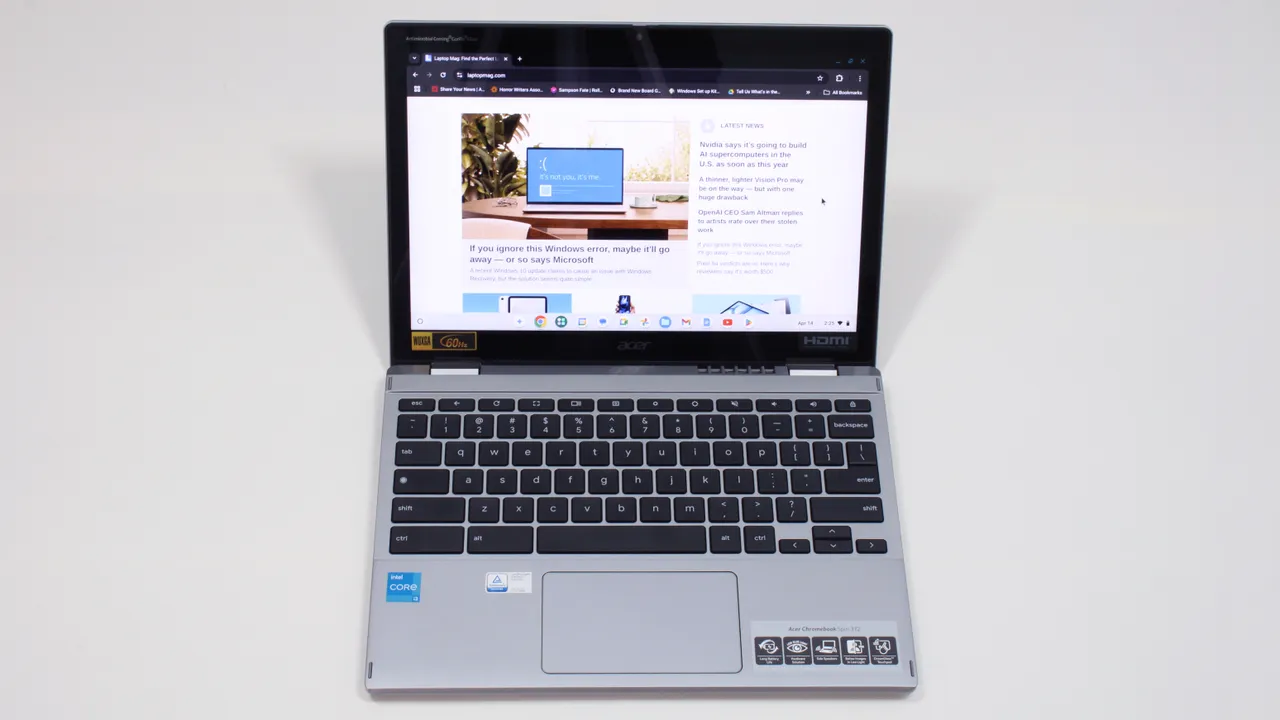
At first glance, the brushed-aluminum exterior of the Averatec N3400 invites comparisons to another ultraportable that costs almost twice as much: theMacBook Air. However, side by side, the Air is almost half as thin as the N3400, which checks in at a hair under 1 inch thick at its thickest. Otherwise, they're almost exactly the same depth and width: 12.8 x 9.0 inches. Inside, the N3400 has a black bezel, keyboard, and keyboard deck, whose palm rests tended to pick up fingerprints. Weighing 3.8 pounds (and 4.6 pounds with its external optical drive), the N3400 is almost a pound heavier than theMSI X340, but the N3400 feels more sturdy.
While, like many of its ilk, the N3400 doesn't have an internal optical drive, the notebook ships with an external DVD burner. Coated in a soft rubber, the external drive contrasts nicely with the N3400's metallic skin.
Keyboard and Touchpad

Click to enlargeThe N3400's keyboard reminds us of that on theAcer Aspire One 751h; the keys are flat on top and not tapered, and while there's space between them, it's not enough to be considered an island-style layout. The keys have a texture that enhanced our grip without chafing our fingers, though we wish they were slightly more responsive. Occasionally, the keyboard would fail to register a letter when we were typing quickly, and not pressing down on the keys all the way.
The touchpad on the N3400 had little friction, and is fairly spacious for a 13-inch system. Two rows of icons on the top and bottom of the pad can be used as quick-launch keys to adjust the volume, open e-mail, launch the Web browser, or perform user-defined actions.
In order to use the buttons, you first have to press the icon in the upper right-hand corner, which switches the touchpad into Dual Pad mode. While in this mode, you can't use the touchpad as you normally would; you have to switch back to touchpad mode first. While it's nice having the functionality of quick-launch buttons, the extra step needed to activate them minimizes their usefulness; it would be much better if there were simply a row of buttons above the keyboard instead.
The touchpad also supports multitouch gestures; by dragging two fingers across the pad, you can scroll through open windows, rotate images, and zoom in and out of pages.
Display and Audio

Click to enlargeThe Averatec N3400's 13.3-inch display has a resolution of 1280 x 800 pixels, which is better for viewing Web pages than the horizontally-oriented 1366 x 768 found on competitors such as theLenovo IdeaPad U350. While the display is glossy, horizontal viewing angles were decent. People sitting on either side of the notebook could comfortably enjoy Saturday Night Live clips streamed from Hulu.
The speakers on the N3400 were adequate for an ultraportable system. When cranked to full volume, audio could easily be heard from across the room, but higher tones, such as the high-hat in Lupe Fiasco's "Go Go Gadget Flow" were a bit tinny. When playing a DVD of Superbad using the external drive, audio levels were not as high; we had to sit close to the system in order to hear dialogue.
Ports and Webcam
On the right side of the system are two USB ports, and headphone and mic jacks. A VGA and Ethernet port, towards the rear on the right side, are hidden by a removable plastic cover, similar to that on theASUS Eee PC 1008HA. On the left side of the system is a third USB port and a 4-in-1 memory card reader.
An integrated 1.3-megapixel webcam in the bezel of the Averatec N3400 was very good during video chats; when using Skype, skin tones were represented well, there was little motion blur, and the embedded mic picked up our voice clearly and cleanly.
Performance
Powered by a 2.16-GHz Intel Pentium Dual Core T3400 processor and 3GB of RAM, the N3400 did very well for an ultraportable on our tests. Its score of 3,017 on PCMark Vantage is a little over 200 points higher than the category average, and twice that of the Lenovo IdeaPad U350, which is equipped with a 1.3-GHz Intel Pentium SU2700 ultra-low voltage processor and 4GB of RAM. Anecdotally, we were able to play a movie from the DVD drive, surf the Web, and write this review without a problem.
On the LAPTOP Transfer Test (duplicating 4.97GB of mixed media), the N3400's 250GB, 5,400-rpm Hitachi drive notched a rate of 19.3 Mbps--exactly the ultraportable average. It was able to boot the system to Windows Vista Home Premium in 48 seconds--more than 10 seconds faster than average, which is more attributable to the lack of trialware than the hard drive itself.
The integrated Intel GMA X4500MHD graphics chip returned predictably low results: In 3DMark06, the N3400 scored 652, which is 200 points below the ultraportable average, but on a par with the MSI X340. Far Cry 2 returned a rate of 3 frames per second with the resolution set to 1024 x 768 and graphics set to optimal.
However, the GPU was able to handle less intense tasks fairly well. A DVD of Superbad played off the external drive without skipping or pausing, and a fly-over of Manhattan in Google Earth was smooth, though 3D buildings took a few seconds to completely render. Also, the N3400 was able to convert a 5:05 MPEG-4 file to AVI in 8 minutes and 12 seconds, about half as long as the ultraportable average (15:41), and almost three times as fast as the Acer Aspire Timeline 3810T (22:18).
Heat and Noise

Click to enlargeWhile the keyboard and touchpad on the notebook remained fairly cool while in use (the temperature between the G and H keys and the touchpad never exceeded 90 degrees Fahrenheit), we measured a temperature of 98 degrees by the air vent on the underside while running our transcode test. Regardless of activity, the N3400's fan was relatively noisy; we could hear it whirring even when just using Firefox and writing this review in OpenOffice.
Battery Life and Wi-Fi
The battery on the N3400 lasted just 3 hours and 1 minute. That's pretty low compared to the category average (5 hours) and theAcer Aspire Timeline 3810T(8:05), but not as bad when you consider the IdeaPad U350 and MSI X340 both only lasted about 3:30. However, the battery is not easily replaceable; you must unscrew the bottom cover in order to access it.
The N3400's 802.11n Wi-Fi radio also turned in disappointing scores of 18.9 Mbps and 14.6 Mbps from 15 and 50 feet, respectively. Both are below the ultraportable averages (19.7/16.8 Mbps). The N3400 also comes with a built-in Bluetooth radio.
Green Testing
The Averatec N3400 isn't very energy efficient. The notebook took 2 hours and 36 minutes to fully recharge, and used an average of 35.6 watts during that time. On the LAPTOP Battery Efficiency Test (the total watts used while recharging divided by battery life), the N3400 used 30.7 watts per minute of battery life. That's 8 watts more than the ultraportable average, and more in line with the thin-and-light average of 29.5 watts. The N3400 has yet to be rated by EPEAT (Electronic Product Environmental Assessment Tool).
Configurations

Click to enlargeAveratec only sells the configuration of the N3400 that we tested. Users can add an additional 5GB of RAM on their own, although in order to do so, the entire bottom panel of the notebook must be removed.
Software and Warranty
Very little software comes preinstalled on the N3400--just Norton AntiVirus and the WildGames suite. However, the lack of apps borders on paucity; the notebook doesn't even come with a word-processing program.
Averatec backs the N3400 with a one-year limited warranty and one-year of technical support, which is available Monday through Friday, 11 a.m. to 8 p.m. EST.
Verdict
The Catch-22 of low-cost ultraportables--at least so far--seems to be that you can have performance or endurance, but not both. The $799 N3400 out-muscles the MSI X340, the Lenovo IdeaPad U350, and the Acer Aspire Timeline 3810T, but the battery--which should be a priority on systems as small and light as these--lasts less than all of them. Still, the Averatec N3400 is worth a look: of all the sub-$800 ultraportables we've tested, it has the sleekest, sturdiest build, and the best performance. Just don't stray too far from an outlet.
Averatec N3400 Specs
| Brand | Averatec |
| CPU | 2.16-GHz Intel Pentium Dual Core T3400 |
| Card Slots | 4-1 card reader |
| Company Website | http://www.trigem.com |
| Display Size | 13.3 |
| Graphics Card | Intel GMA X4500MHD |
| Hard Drive Size | 250GB |
| Hard Drive Speed | 5,400rpm |
| Hard Drive Type | SATA Hard Drive |
| Native Resolution | 1280x800 |
| Operating System | MS Windows Vista Home Premium |
| Optical Drive | DVD /-RW DL |
| Optical Drive Speed | 8X |
| Ports (excluding USB) | VGA, Microphone, Headphone, Ethernet |
| RAM | 3GB |
| RAM Upgradable to | 8GB |
| Size | 12.8 x 9.0 x 1.0 inches |
| USB Ports | 3 |
| Video Memory | 134MB |
| Warranty/Support | One-year limited/one-year technical support, Mon.--Fri., 11 a.m. to 8 p.m. EST. |
| Weight | 3.8 lbs |
| Wi-Fi | 802.11n |