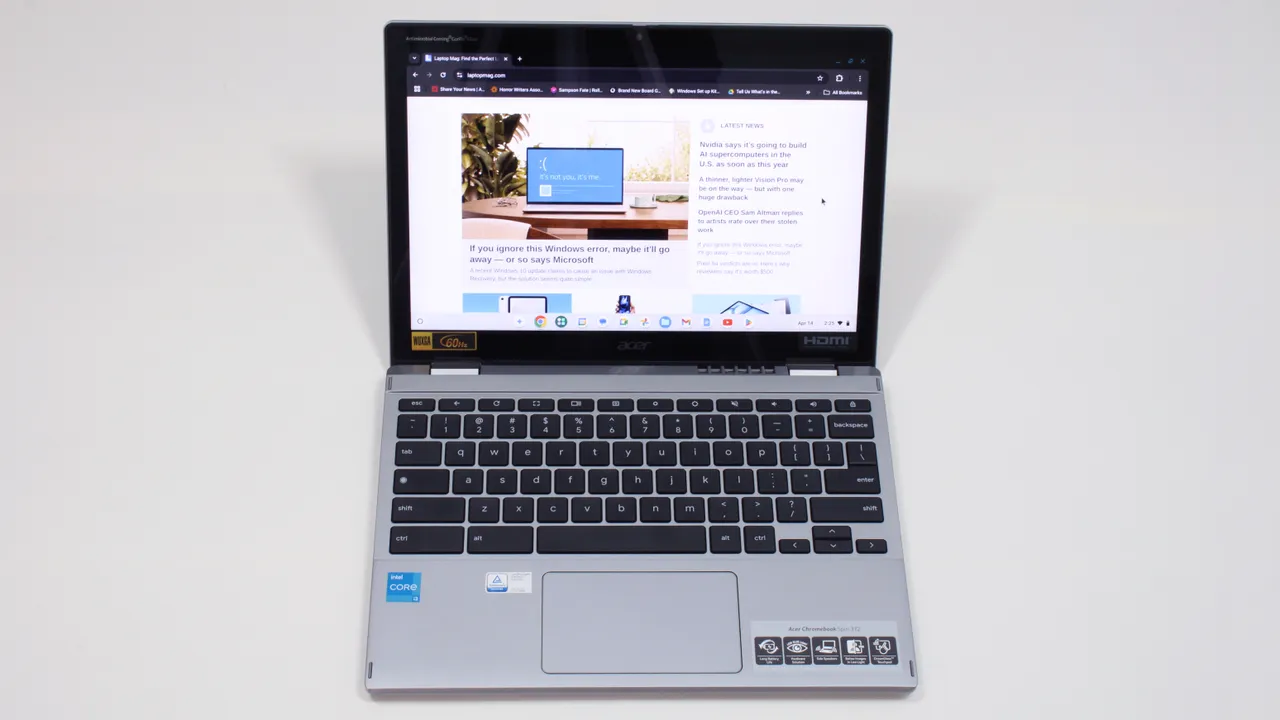
Think back to the laptop you had in 2008. It probably doesn't look too different from what you're using today. Sure, your current notebook is lighter than the brick you lugged around five years ago, and it's running Mountain Lion or Windows 8 rather than Vista or Leopard, but it's still a clamshell laptop with the same basic functionality. Fast-forward to 2018, and your computing experience will be radically different — but familiar, too.
Rather than phasing out the traditional laptop, manufacturers are shaping future PCs around emerging trends. For instance, the prominence of mobile devices has spawned thinner Ultrabook designs and detachable tablet-laptop hybrids. Notebooks will also benefit from perceptual computing breakthroughs that will push eye and motion control into the mainstream. Imagine looking at an app to open it or simply glancing up or down to scroll.
Here's what to expect from your laptop in 2018.

Form Factors: From clamshells to detachables
A study from Gartner in April predicted that tablet sales would surpass laptop purchases by 2015. Despite this unpromising outlook, experts agree that the traditional keyboard and hinged display form factor won't disappear anytime soon.
MORE: Top 8 Windows Tablet-Laptop Hybrids
Howard Locker, a Lenovo executive working on the company's R&D team, compared the clamshell form factor to a piano. Like a notebook, the keys on a piano and its sheet-music holster are positioned conveniently in relation to our hands and our eyes — a design that will always be crucial for computers as well.

"There's always going to be a need to work with my hands and my eyes at the same time doing something," Locker said. "And the clamshell is the perfect form factor for that, with input on the bottom and visual on top. And that's never going to go away. I don't think the notebook is ever going to go away."
While some analysts predict that tablets will outpace laptops as early as this year, others believe slates can't replace the traditional typing experience.

"There's still something to be said for typing on a keyboard rather than a piece of glass," said Tom Butler, director of Lenovo's ThinkPad division. "We know that we're just more efficient on a standard keyboard. Now, there will be innovation that will come along and help extend the capabilities of typing on glass, but having that full, rich keyboard experience is still very relevant in that time frame."
MORE: 10 Best Lenovo Laptops
That's not to say some alterations in design shouldn't be expected, though. Butler said this is still the first generation of detachable devices, which means that in 2018, laptops with removable keyboards and dual laptop-tablet functionality will likely be the norm.

Gesture control goes mainstream
When Windows 8 made its debut in 2012, touch-screen displays quickly became standard for premium notebooks. According to IHS, nearly a quarter of all laptops will have touch screens by 2016, thanks to falling prices.
But touch-enabled displays are only the beginning when it comes to new methods of interacting with computers. By 2018, using your eyes to play games on your PC or waving your hand to navigate the desktop will be mainstream ways to interact.
Devices such as Microsoft's Kinect have already popularized gesture control in the gaming industry, but numerous vendors are pushing to make gesture controls a key part of the everyday computing experience. Take the $79 Leap Motion Controller, a compact peripheral that lets you do everything from flip through photos and shoot enemies just by moving your fingers. HP has agreed to integrate Leap's technology directly into laptops in the near future.
"We think there's something inherently powerful about just opening up [your laptop] and having the space above your computer transform into something interactive," said Andy Miller, president and chief operating officer of Leap Motion. "And when you think about it, we're really just scratching the surface."
Meanwhile, Creative is partnering with Intel to put its Senz3D gesture-based webcam inside upcoming notebooks by the second half of 2014. Forget about the exaggerated waves and overpronounced full-body movements you're accustomed to with the Kinect. Gesture-based technology is evolving quickly — so quickly that devices will be able to detect even the slightest movement when it comes to navigating your PC.
The upcoming Creative Senz3D camera, which could be available as a peripheral by the end of this year, has dual-lens technology that creates a deeper depth of field to enable realistic and lifelike 3D interaction. This means that rather than simply waving your hand left, right, up or down, you can actually reach toward the screen to grab and throw objects in a game.
The camera adds a more intimate and interactive layer to gaming, as demonstrated in the Senz3D-optimized version of Valve's Portal 2, which will come bundled with the camera as a free download. By subtly moving your hand, you can use real-life gestures to pick up Companion Cubes and throw them across the room or pan around your environment.
To support these burgeoning modalities, future laptops are likely to come with multiple integrated cameras that feature advanced sensors.
"There may be two, there may be three, there may be four [cameras], but it's not going to appear to us as anything too different from what we're seeing at the top of our laptops today," said Sanjay Patel, CEO of Personify Inc. The company is partnering with Intel to bring its Personify Live app to the Creative Senz3D camera.
Eye control
Perceptual computing is likely to heavily influence your future laptop, but that doesn't stop at gesture control. In five years, you'll be able to breeze through your laptop's interface by simply looking where you would typically point your mouse cursor.
Tobii's Rex peripheral, which has been available for $995 for developers since January and will see limited consumer availability this fall, lets users navigate the Windows 8 OS and interact with certain applications by simply looking around the screen. But the camera does more than let you move the cursor.

In terms of everyday use, a device such as the Rex could enable you to browse through emails by simply looking up and down your inbox, or to open apps by staring at a particular Live Tile in the Windows 8 interface.
"It's all about the relationship you have with your device in terms of sight and being able to detect what you're looking at, what you're interested in and what you want to act on," said Carl Korobkin, vice president of business development at Tobii Technology. "And that's what we do."
Imagine what it would be like to play "L.A. Noire" if staring at the characters' facial expressions actually provoked a visible reaction? Or, picture yourself perusing a map in an "Elder Scrolls" game by naturally moving your eyes to your desired destination. What if you could zero in on your target by simply looking at it rather than having to aim with your mouse?

Tobii recently announced the first Ultrabook prototype that comes with its built-in eye-tracking camera, which is intended to demonstrate how the technology will be integrated into future products. Tobii says its OEM partners are working on devices with more advanced versions of this eye-tracking technology that could hit the market as early as next year.
The mouse disappears; touchpads stay
Between touch screens, touchpads and the occasional stylus, today's devices come with enough modalities to diminish the need for a mouse. As these technologies and perceptual computing continue to evolve, the mouse will become less relevant.
"I do believe the mouse is going to be displaced, and potentially fairly rapidly," Korobkin said. "But that will take some time. It depends on what applications are available, but I do think that the mouse is reaching the end of its run."
Manufacturers are beginning to see the effects of these emerging technologies as well. Earlier this year, Logitech, the world's largest mouse maker, suffered a massive net loss of $195 million. Touch-screen usage is only expected to increase over the next five years, although these panels are still considered relatively expensive.
"OEMs [original equipment manufacturers ] and ODMs [original design manufacturers] will follow these standards when manufacturing notebooks," Peter Lin, senior analyst for compute platforms at IHS, said, referring to the prominence of touch screens in hybrids and laptops. "However, the touch panel is in shortage, and it takes time to expand the capacity and increase the yield rate. It's not easy to get touch panels — and the price is still high — but IHS considers it will be solved in about one to two years."

Based on current sales trends, Lin believes that touch-screen capabilities, gesture support and voice recognition will be the most desired characteristics in future PCs. Still, despite these burgeoning modalities, there will always be a place for the touchpad on your notebook, according to Locker.
"I think everything [perceptual computing] is just an overlay," Locker said. "The advantage of the touchpad is that it's very intuitive because it's tactile. If you're in clamshell mode, it's much easier on your body to touch the touchpad than reach out and touch the screen. It's a physical thing, so I really don't see it going away."
All-day battery life
Just about every day, we use our smartphones to surf the Web, send text messages and play games — only to plug them in again before we go to bed (or maybe charge it twice per day, if you use it a lot). Unfortunately, the reality is quite different for laptops, with many models in our tests lasting less than 5 hours on a charge. But all-day battery life could become a reality by 2018.

"The beauty of it is, we're seeing decreases in thermal [power required by the device’s cooling system] and significant increases in performance and CPU capabilities," said Lenovo's Butler. "If you fast-forward to the not-too-distant future, you're going to see much thinner and much lighter devices with significantly longer battery life." Butler said we won't need to worry about having to hunt for an outlet halfway through the day.
IHS' Lin added that although battery life can be an obstacle for manufacturers, major vendors are working to provide "very low power" CPUs for future devices. We're already seeing battery-life enhancements with Intel's newly launched Haswell chip, which promises a 20 percent increase in endurance because it requires less wattage to run applications. For instance, watching HD video used to require 8W of power, and Intel's fourth-generation chip now only needs 6W. According to Lin, Intel will have to shrink down the TDP wattage in its CPUs to 1 or 2 by 2018, which AMD is also on pace to accomplish.
Looking toward the future
The PC landscape is changing rapidly, but that doesn't mean the laptop as we know it will become obsolete. Five years down the road, your typical notebook is likely to come with an advanced touch screen with more precision than those found in today's notebooks.
You'll be able to play games and interact with certain applications by simply looking at them. Your PC will rely on sensors to perceive your gestures and determine your location, and all-day battery life will be the new standard. And the advent of wearable technology and perceptual computing will influence the way we interact with computers as a whole.

"The operating system actually becomes the environment around you," Korobkin said in reference to augmented reality. "Whether it's something we wear on our head or something we interact with that projects images in front of us, that's what I'm picturing in terms of the future of computing environments."
The current generation of detachable PCs and laptop-tablet hybrids is just the first of many iterations to come, leaving plenty of room for more advancements and innovation.
"The laptop of the future has to be far more aware and far more perceptual than the devices we're seeing today," said Patel. "It's a trend that's inevitable."